Short answer: A whole-house surge protector (SPD) installed at or near the main electrical panel intercepts high-voltage transients from lightning, utility switching, and grid faults before they reach branch circuits, clamping the voltage to a safe level in nanoseconds. The 2020 and 2023 National Electrical Code now require an SPD on all new dwelling-unit services and service replacements (NEC Article 230.67), reflecting how routine and damaging these grid events have become.
Most homeowners picture power surges as rare lightning strikes, but the electrical grid produces small transient spikes constantly — from utility switching, nearby motor start-ups, and grid faults — and each one nudges appliance electronics a little closer to failure. This guide explains what a whole-house surge protector actually does, how it’s wired into a panel, what the code requires, and how to size one correctly for a real home.
What a Whole-House Surge Protector Actually Does
A surge protective device (SPD) is not a fuse or a breaker — it’s a voltage-clamping device that sits in parallel with the circuit and stays invisible until a transient voltage spike arrives, at which point it diverts the excess energy to ground (Schneider Electric electrical-installation guide). It has been compared to a pressure relief valve: it does nothing during normal operation and only reacts when voltage exceeds a defined threshold, redirecting the surplus current before it reaches sensitive electronics (LPS France surge protection guide).
Once installed at the service entrance or main panel, the SPD becomes the first thing an incoming transient encounters — well before it can propagate through the home’s branch wiring to refrigerators, HVAC control boards, water heaters, or networked smart-home devices (Generac SPD product specification). This is different from a point-of-use power strip, which only protects whatever is plugged directly into it and does nothing for hardwired appliances like ovens or HVAC compressors.
Two Kinds of Surges: Sudden and Cumulative
Direct lightning strikes are the most dramatic surge event, but they’re not the most common source of appliance stress. Utility grid switching, transformer faults, and the start/stop cycling of large motors (air conditioners, well pumps, elevators) generate frequent internally-induced surges that are individually smaller but occur far more often (Schneider Electric). Each of these repeated low-grade transients degrades semiconductor components incrementally, which is why appliances with circuit boards sometimes fail years before their expected service life without ever experiencing an obvious lightning event.
SPD Types: Where Each One Belongs in the System
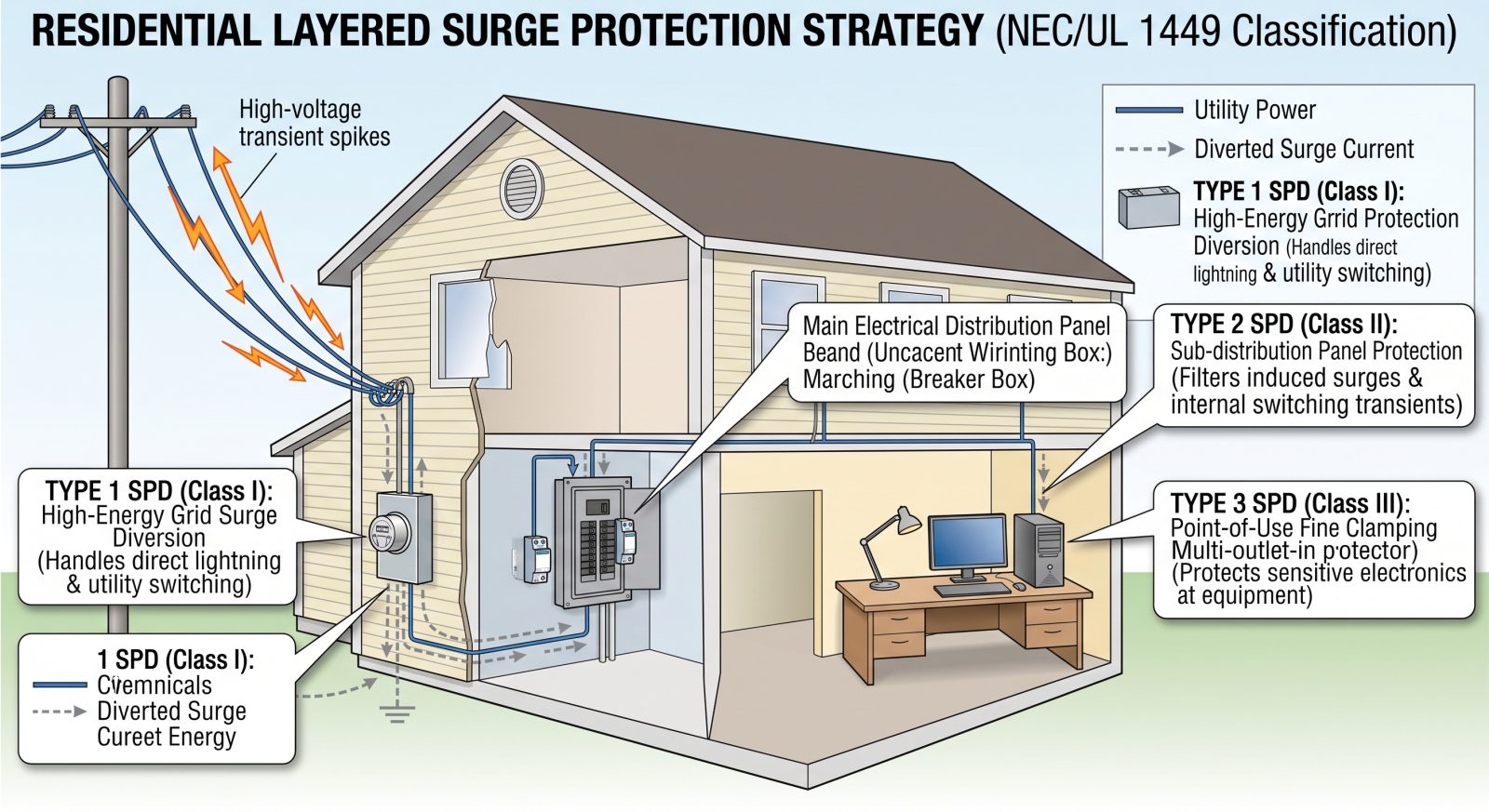
International (IEC 61643-11) and North American (UL 1449) standards classify surge protective devices into three types based on where they sit in the electrical system and what surge energy they’re built to survive.
| SPD Type | Test Waveform | Installation Location | Primary Role |
|---|---|---|---|
| Type 1 (Class I) | 10/350 µs (high energy, lightning current) | Service entrance, line side of main disconnect | Handles direct and near-direct lightning current entering the service (LSP Global SPD comparison guide) |
| Type 2 (Class II) | 8/20 µs (medium energy) | Main or sub-distribution panel, load side of main breaker | Filters induced surges and internal switching transients; the standard residential baseline (LSP Global) |
| Type 3 (Class III) | 1.2/50 µs + 8/20 µs combination wave | Point-of-use, at least 10 m (30 ft) of wire from the panel | Final fine-clamping stage for sensitive electronics; cannot be used standalone (LSP Global) |
For most homes, a Type 2 SPD installed at the main panel satisfies code and provides effective whole-house coverage; a Type 1 becomes necessary in addition when the building has an external lightning protection system or an overhead utility service, since Type 1 devices handle far larger lightning-current duty (LPS France). The 2023 NEC explicitly permits either Type 1 or Type 2 to satisfy the whole-house SPD mandate for dwelling units (CITEL NEC 2023 Article 230.67 summary).
What the Code Requires
NEC Article 230.67(A) states plainly that “all services supplying dwelling units shall be provided with a surge-protective device” (DITEK NEC 2023 surge protection rules). This requirement, introduced in the 2020 NEC and carried into 2023, applies to both new service installations and any service equipment replacement — meaning a homeowner upgrading an aging panel is now also required to add SPD protection at the same time (NFPA summary of 2020 NEC residential changes).
- The SPD must be an integral part of the service equipment or located immediately adjacent to it, with an exception allowing installation at the next distribution panel downstream (NEC 230.67(B)).
- The device must be Type 1 or Type 2 — plug-in Type 3 devices do not satisfy the code requirement on their own (NEC 230.67(C)).
- Whenever service equipment is replaced, the SPD requirement applies retroactively to that replacement (NEC 230.67(D)).
How Installation Works
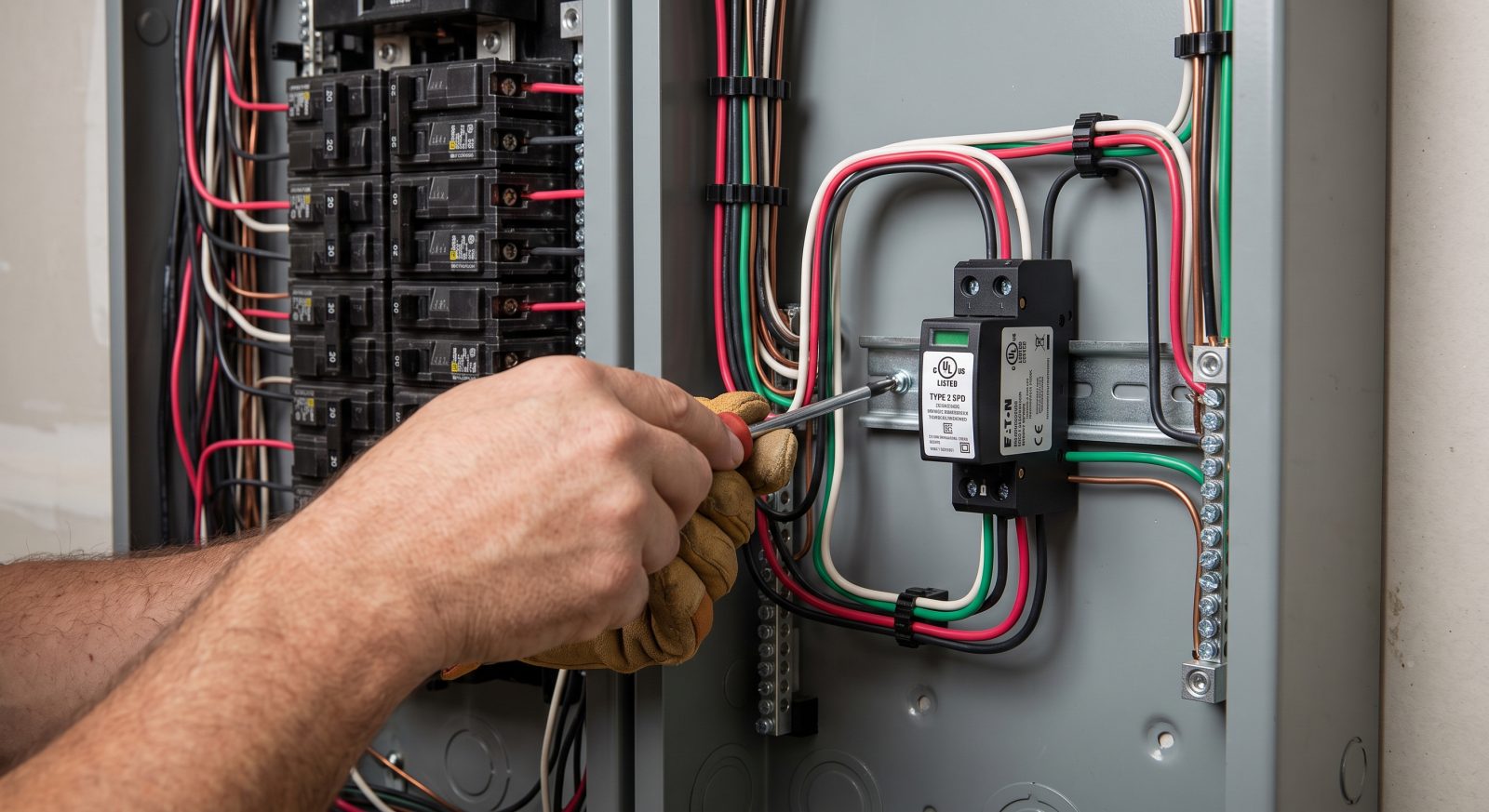
A code-compliant whole-house SPD is never wired directly to the panel’s bus bars — it must connect through its own dedicated two-pole breaker, typically rated 20A or 30A depending on the manufacturer’s instructions (residential electrical installation guide). Skipping the dedicated breaker defeats the overcurrent protection built into the design and is an explicit NEC 285.23 violation (same source).
- Turn off the main breaker, then every branch breaker, and verify the panel is dead with a non-contact tester and multimeter before touching any wiring (installation guide).
- Snap a dedicated two-pole breaker into the panel, positioned as close to the main breaker as possible to minimize wire run length, and leave it off.
- Remove the nearest knockout, install a cable clamp, mount the SPD housing, and route its leads into the panel through the connector.
- Connect the phase leads to the new breaker, and the ground/neutral leads to their respective bus bars, keeping all conductors short, straight, and free of sharp bends.
- Restore power in sequence: main breaker first, branch breakers next, and the SPD breaker last (installation guide).
The SPD should sit within about 12 inches of the main breaker, measured along the actual wire path rather than straight-line distance, because lead length directly affects clamping performance — longer leads add inductance that raises the voltage let-through during a fast transient (installation guide). This is one reason DIY installation is discouraged for anyone not comfortable working inside a live-voltage panel; miswiring an SPD, or failing to torque connections to spec, can create a fire hazard rather than a safeguard.
Grounding and Bonding Are Not Optional
An SPD is only as effective as the ground path it relies on to shunt surge current away from the wiring. Industry technical guidance is direct on this point: “a poor ground, or a grounding/bonding violation will seriously affect the SPD’s ability to function as specified” (Eaton SPD installation manual). NEC Article 250 governs the required grounding electrode system and conductor sizing, typically an 8-foot ground rod and a grounding electrode conductor sized per NEC Table 250.66 (grounding and surge protection compliance guide). Best practice recommends exothermic welds or listed mechanical connectors rather than simple “acorn nuts,” along with periodic ground-resistance testing to confirm the path stays below 25 ohms as required by code, with 5 ohms or less recommended for critical installations (THOR Systems grounding and bonding application note).
Sizing a Whole-House SPD Correctly
Three specifications determine how well an SPD performs: surge current rating (kA), energy absorption (joules), and voltage protection rating (VPR, sometimes called clamping voltage). Getting these wrong means either overpaying for unnecessary capacity or under-protecting a home with heavy electrical load.
| Home profile | Recommended kA rating | Recommended joule rating | Notes |
|---|---|---|---|
| Small home, few electronics | 40–60 kA (Britec Electric sizing guide) | 400–600 J minimum | Meets baseline code requirement for typical low-exposure areas |
| Average-sized home, standard 200A service | 60–100 kA | 2,000 J or more (whole-home surge protector buying guide) | Widely used baseline; a 200A service commonly pairs with a 100–120 kA unit |
| Large home, many high-value electronics, EV charger, solar | 100–140 kA, up to 200 kA in high-lightning regions (SPD Type 1 vs Type 2 buying guide) | 2,000+ J | Consider a layered approach with point-of-use Type 3 protection at sensitive equipment |
The 2023 NEC additionally requires a minimum nominal discharge current (In) of 10 kA for qualifying SPDs, and any device chosen should also carry UL 1449 listing and a short-circuit current rating (SCCR) that meets or exceeds the available fault current at its installation point (SPD buying guide). Lower VPR values are better — a common residential target is 500V or below across L-N, L-G, and N-G modes — since a lower clamping voltage means less transient energy actually reaches downstream wiring and appliances (George Brazil surge protector buying guide).
Layered Protection: Why Whole-House Alone May Not Be Enough
A single Type 1 or Type 2 device at the panel stops the largest surges from reaching the house’s wiring, but industry guidance consistently recommends supplementing it with Type 3 point-of-use protection for the most sensitive and expensive equipment — computers, home theater systems, and networking gear — because a small residual voltage can still pass through the panel-level device during a severe event (Florida Electrical Specialists surge protection guide). Type 3 devices are explicitly designed to work only as a supplement, never as a standalone substitute for panel-level protection (Trilpeak SPD comparison guide).
Why This Matters: The Real-World Damage Picture
Lightning-related insurance claims in the United States rose to 61,986 in 2025, up 11.6% from 55,537 the year before, according to the Insurance Information Institute (Triple-I) (Triple-I 2025 lightning claims report). That trend underlines why code bodies moved from treating whole-house surge protection as optional to making it mandatory: the annual volume of grid and lightning-related transient events large enough to trigger insurance claims continues climbing year over year, and each of those events puts every hardwired appliance in an unprotected home directly at risk.