You stand in the center of your living room on a quiet Saturday afternoon, the faint, sharp scent of fresh vinyl unrolling across the floor. Smoothing that first panel of botanical print onto the bare drywall feels like a victory. The room instantly softens, taking on a personality it never had when it was just an empty white box. For anyone renting, this moment offers a rare sense of ownership, a tactile claim over the space you inhabit.
But the victory is often fragile. A few weeks later, you might wake to the distinct, heart-sinking sound of peeling vinyl collapsing behind the sofa in the middle of the night. You press the curled edges back into place, but the bond is broken. The standard expectation—just peel, stick, and walk away—rarely holds up against the quiet reality of domestic environments.
The culprit behind this slow-motion disaster is rarely a defective product or poorly prepped paint. It is the invisible air around you. The ambient climate of your home dictates how materials behave long after you throw the packaging away, silently working against your weekend project.
Understanding this changes everything. You realize that thermal shock destroys adhesives entirely on a microscopic level, turning a temporary decor upgrade into a frustrating chore. Normal room temperature fluctuations cause the backing to expand and contract, steadily weakening its grip on the wall until gravity inevitably wins.
The Invisible Grip of Thermodynamics
Think of adhesive backing less like traditional wet glue and more like cold butter. If you attempt to spread a chilled block directly onto soft bread, it stubbornly holds its shape, tearing the surface and clumping into useless ridges. But if you allow it to soften on the counter, it yields, melting seamlessly into every tiny pore and crevice of the toast.
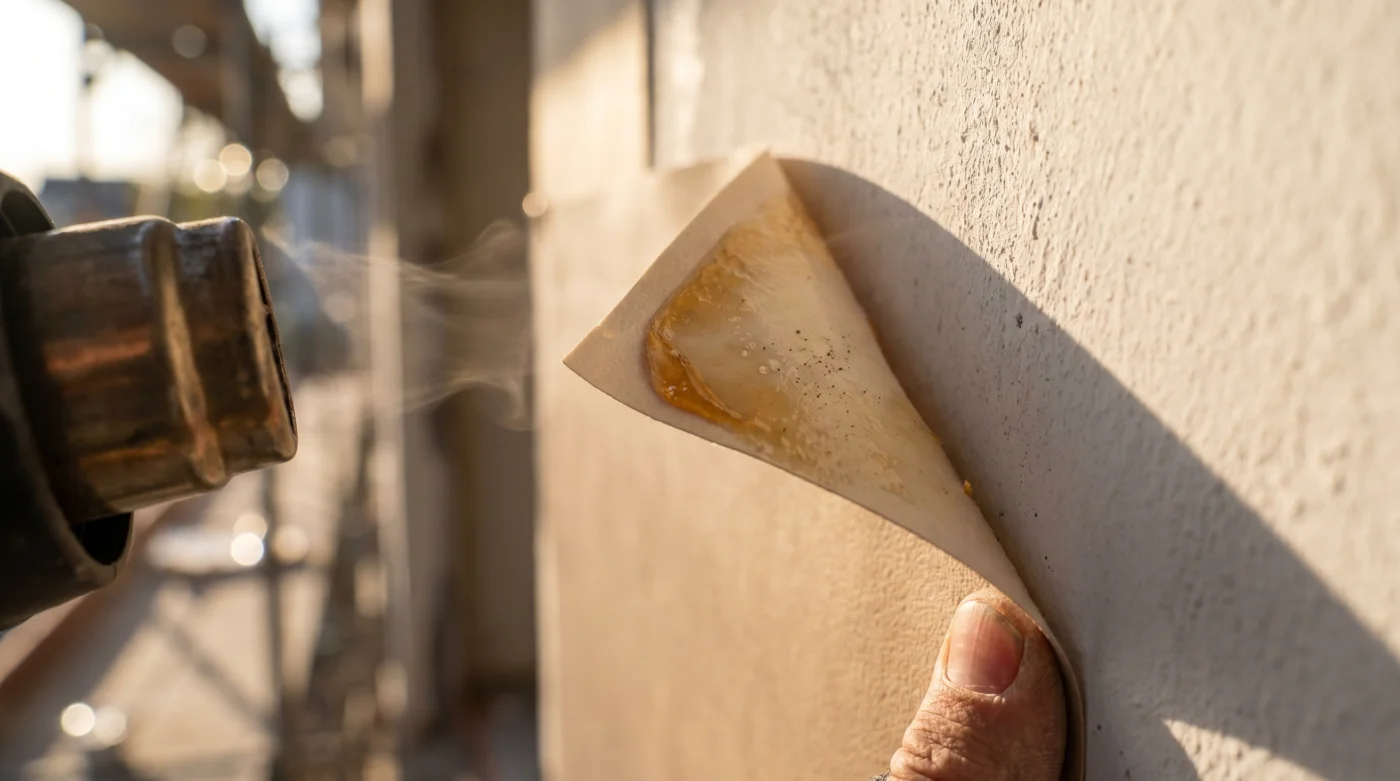
When you apply cold or stiff vinyl to a wall, the adhesive sits rigidly on the highest peaks of the paint texture. The secret to a permanent, flawless hold is pre-heating your vinyl panels. By gently warming the material, you coax those stiff polymers into a relaxed, liquid-like state that conforms perfectly to your wall.
This subtle intervention flips a mundane vulnerability into a structural advantage. Not only does the warmed adhesive wrap tightly around the microscopic texture of your drywall to prevent curling, but it also cures evenly. Ironically, this same thermal control guarantees zero sticky residue upon removal. When the adhesive bonds uniformly, it peels away uniformly, leaving your security deposit perfectly intact.
Meet Elias Thorne, a 42-year-old set designer working out of drafty Brooklyn lofts. Elias transforms sterile rental spaces into lived-in, textured homes for week-long editorial shoots, only to strip them back to white walls days later. His most trusted tool isn’t an imported smoothing brush; it is a standard, inexpensive hairdryer. Years ago, Elias realized that forcing cold wallpaper onto walls was a losing battle against the vibrating subway drafts outside. By taking three extra minutes to warm the back of the panels before application, he managed to lock the heavy paper in place, ensuring the walls underneath remained pristine when the shoot wrapped.
Adapting to Your Domestic Climate
Every home breathes differently, shifting with the hours of the day. To truly master this technique, you must adapt to the specific thermal rhythm of the room you are transforming, reading the space before you ever make a cut.
For the drafty pre-war apartment, your biggest enemy is the sudden drop in ambient heat when the sun goes down or the radiator cycles off. Cold walls shock the warm adhesive, causing it to snap back and pull at the seams. Keep your thermostat set to a steady 72 degrees Fahrenheit for a full twenty-four hours before you begin, giving the drywall time to absorb the warmth deep into the plaster.
If you are working in a sun-baked, south-facing room, the strategy shifts. Direct afternoon sunlight through large windows can hyper-accelerate the curing process, creating hot spots that bake the adhesive permanently into the drywall paint.
In these glaring spaces, avoid the harsh glare that bakes backing into a concrete-like grip. Install your paper in the early morning or late evening. Let the panels come to room temperature away from the windows, shielding them from the intense UV rays to ensure a gentle, even cure.
Bathrooms and kitchens present a different challenge entirely. Here, fluctuating heat is frequently paired with heavy, lingering moisture from showers or boiling pots, creating a hostile environment for any adhesive.
To combat the invisible layers of surface condensation, ensure the room is completely dry and stabilized at a moderate temperature. Run the exhaust fan for an hour before applying the warmed panels, guaranteeing the soft adhesive binds securely to the paint rather than a microscopic film of water.
The Thermal Bonding Protocol
Applying this logic requires a mindful, deliberate pace. Rushing through the installation is exactly how trapped air bubbles, misaligned patterns, and weak seams happen in the first place.
Your goal is to work with the heavy material, not force it against its will. Approach the wall with intention, treating the application as a slow, methodical process where your hands and your tools move in a calm, synchronized rhythm.
Follow this sequence to secure a flawless, damage-free finish:
- Unroll your panels and lay them flat in a room maintained at exactly 70 to 72 degrees Fahrenheit for at least 24 hours.
- Before removing the backing, pass a hairdryer on a medium heat setting over the vinyl surface, keeping the nozzle about six inches away.
- Peel the top edge and press it to the wall, continuing to apply gentle warmth as you smooth downward with a felt-edged tool.
- Once fully applied, run the warm air over the seams one last time, pressing firmly to seal the fragile edges against future moisture.
Keep a tactical toolkit nearby to maintain your focus: a digital room thermometer, a hairdryer with a diffuse nozzle, a soft felt smoothing tool, and a sharp utility knife with fresh snap-off blades. This simple collection replaces brute force with precision, allowing you to execute the installation seamlessly.
Beyond Temporary Walls
Gaining control over something as simple as the temperature of your wallpaper might seem small, but it changes how you interact with your physical space. It shifts your mindset from passive consumer to active curator of your home environment.
You stop crossing your fingers, hoping the heavy paper holds, and instead engineer a reliable, beautiful outcome based on physics. It bridges the gap between living transiently in a rental and treating your home with the permanence, care, and aesthetic respect it deeply deserves.
When you understand the quiet mechanics of the materials around you, frustration turns into capability. You create an environment that feels solid, grounded, and entirely yours, resting easy in the knowledge that when the time comes to move on, you can leave the space as spotless as you found it.
The longevity of any interior modification lies not in the strength of the product, but in our willingness to respect the invisible climate it lives in.
| Key Point | Detail | Added Value for the Reader |
|---|---|---|
| Ambient Acclimation | Rest panels at 72 Fahrenheit for 24 hours. | Prevents shrinking and seam splitting long after installation. |
| Active Warming | Use a hairdryer on medium heat during application. | Forces stiff polymers to relax and securely grip the wall texture. |
| Clean Removal | Uniform bonding prevents isolated tearing. | Guarantees zero sticky residue and strictly protects your security deposit. |
Frequently Asked Questions
Can I use an industrial heat gun instead of a standard hairdryer?
An industrial heat gun often runs far too hot and can easily melt or warp the delicate vinyl. A hairdryer on a medium heat setting provides the perfect, gentle warmth needed to soften the adhesive without distorting the printed pattern.
What if my rental apartment walls are heavily textured?
Warming the vinyl becomes even more crucial in this scenario. The softened adhesive will melt into the valleys of the texture, though highly textured popcorn walls may still require a dedicated, smooth primer layer first.
How long does the adhesive take to fully cure on the wall?
Typically, it takes about 48 hours for the chemical bond to fully set. Keep the room temperature completely stable during this crucial window to ensure the edges do not lift or curl.
Will pre-heating work on traditional, wet-paste wallpaper?
No, this specific technique is reserved strictly for peel-and-stick vinyl backing. Traditional paste relies on slow moisture evaporation rather than thermal polymer bonding to secure the paper.
How do I handle the removal process months or years later?
Simply reverse the original thermal protocol. Warm the top corner with your hairdryer to gently soften the aged adhesive, then pull down slowly at a 45-degree angle. The panel will slide off the paint like a heavy curtain.