Short answer: Polybutylene (PB) pipe is a dull gray, slightly flexible plastic supply pipe installed in roughly 6 to 10 million U.S. homes between 1978 and 1995 (RePipe Solutions). It fails from the inside out as chlorine and chloramine in tap water oxidize the plastic, and because that failure mode is often excluded from standard homeowners insurance, catching it early — before a hidden burst floods a wall, ceiling, or foundation — is one of the highest-value inspections a homeowner can do (RePipe Solutions insurance guide).
If your home was built or renovated between the late 1970s and mid-1990s, there’s a meaningful chance polybutylene is running behind your walls right now, invisible until the day it isn’t. This guide walks through exactly what to look for, why the material fails, what it costs to fix, and how insurance treats it differently from copper or PEX.
What Polybutylene Pipe Actually Is
Polybutylene is a flexible plastic resin piping material that plumbers and builders used heavily for interior and exterior water supply lines from 1978 through the mid-1990s, prized at the time for being cheaper and faster to install than copper (Modern Castle). It was never used for waste, drain, or vent piping — only for pressurized water supply lines (InterNACHI).
Chemically, polybutylene contains tertiary carbon-hydrogen bonds along its polymer backbone that are far more vulnerable to oxidative attack than the bonds found in modern PEX tubing (Polybutylene.ca resource hub). That single structural difference is the root cause of nearly every documented failure.
How to Identify Polybutylene Pipe in Your Home
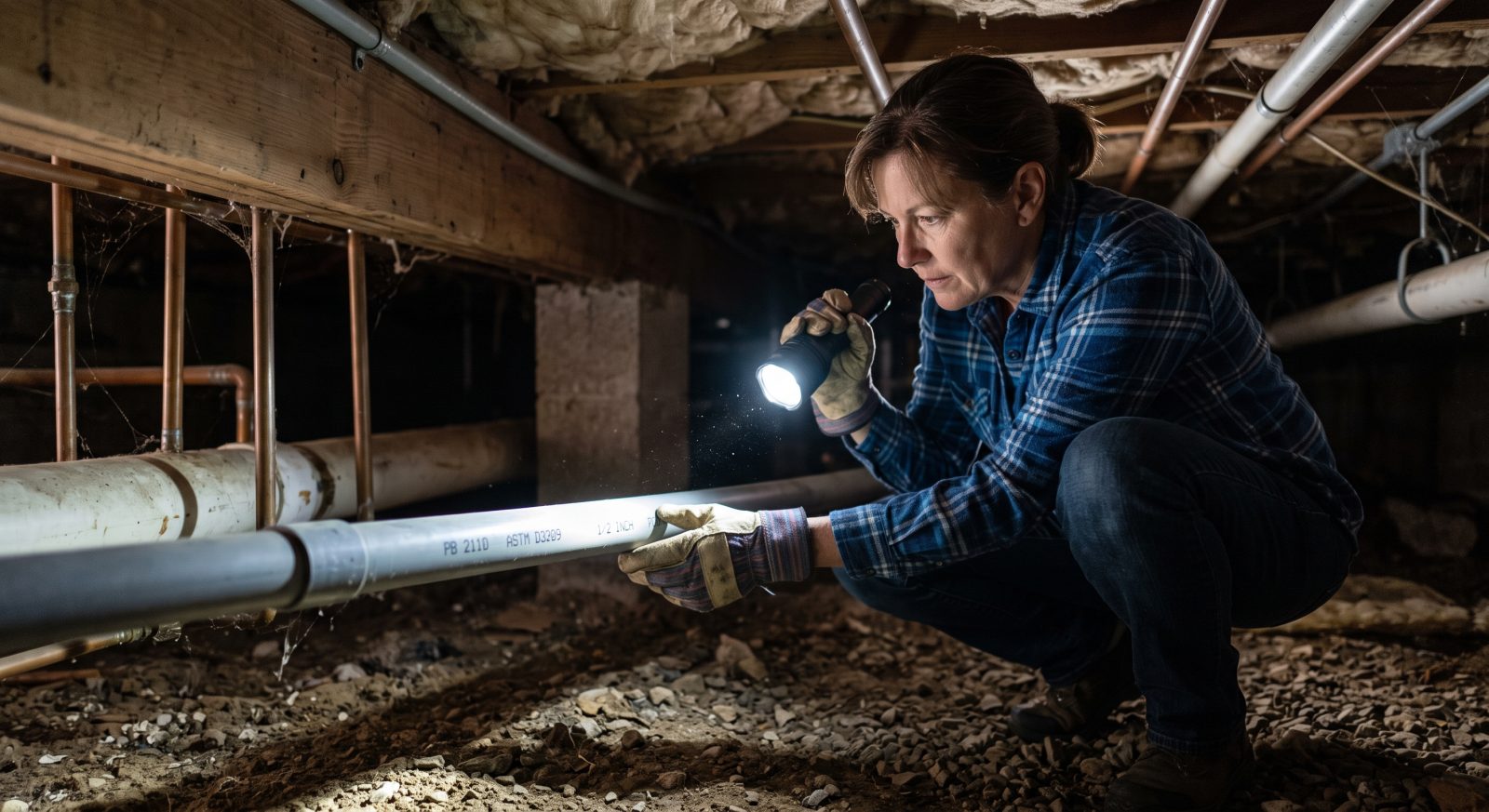
Identification relies on four converging clues — color, stamped markings, fitting type, and pipe diameter — used together rather than any single trait alone (Pearce HVAC).
Color and Texture
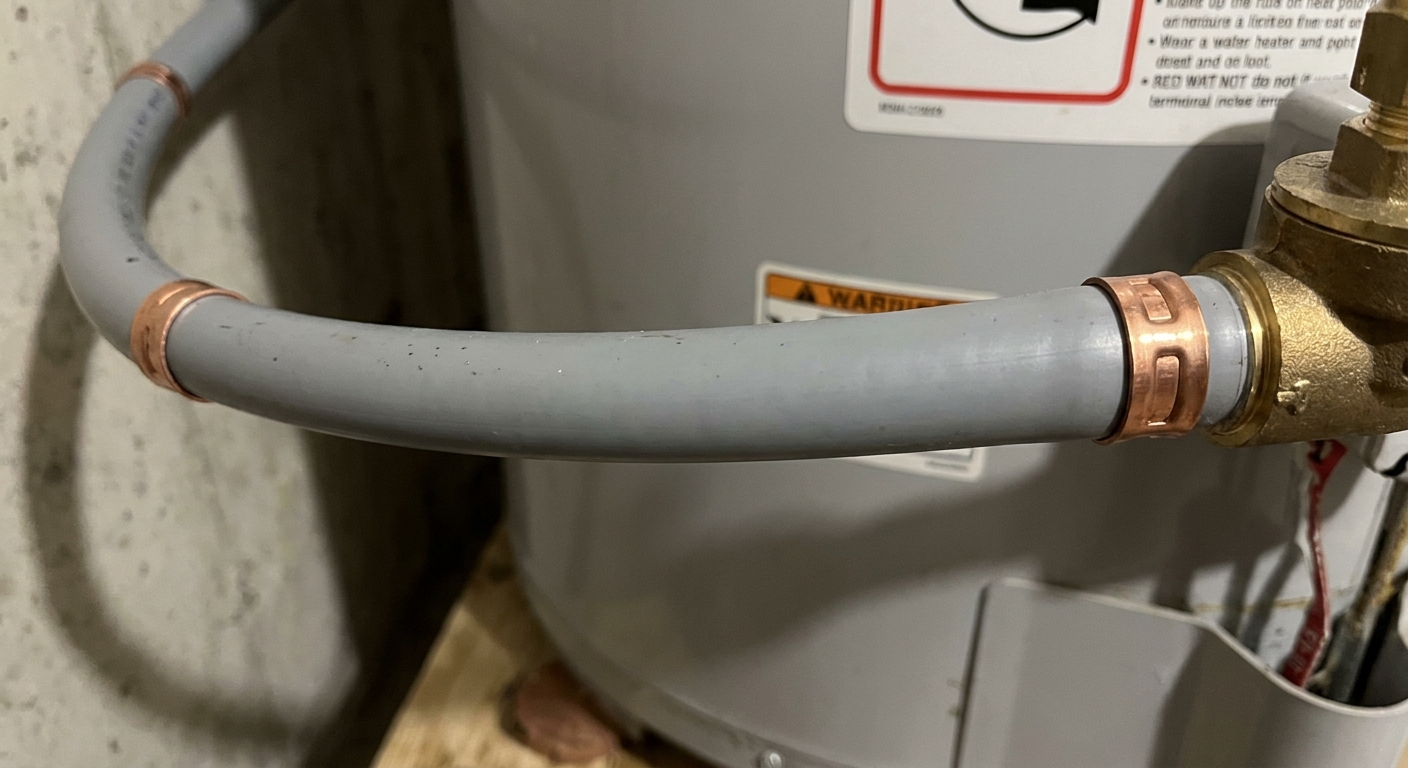
- Color: Most common interior color is a dull, matte gray; blue is common for cold-water lines and buried exterior service lines; black shows up on underground mains; silver and white are less common but possible (InterNACHI)
- Texture: Semi-rigid plastic with slight flexibility — noticeably softer than copper or PVC but stiffer than modern PEX tubing (The Smell Good Plumbers)
- Diameter: Almost always 1/2 inch to 1 inch, roughly the width of a garden hose (DC Plumbing of South Florida)
Color alone is not proof — CPVC and polyethylene can also appear gray or black, so treat color as a first clue that warrants closer inspection, not a final verdict (Pearce HVAC).
The Definitive Stamp: PB2110
The most reliable identifier is printed text running lengthwise along the pipe reading “PB2110”, sometimes accompanied by “ASTM D3309” or, in Canada, “CSA-B137.8” (Plumbing Tips Today). This code repeats every two to three feet along the pipe’s length and is considered definitive confirmation of polybutylene resin (Plumbing Tips Today). Canadian Poly-B pipe often includes a manufacturer name (Vanguard, Shell, Qest, or Bow) and a date code stamped alongside the resin designation (The Smell Good Plumbers, Victoria BC).
Bring a flashlight for dim basements and crawlspaces, since the stamp is easy to miss under dust or paint (Plumbing Tips Today).
Fitting Types
Polybutylene systems almost never use soldered joints. Instead, look for two connection styles:
| Fitting type | What it looks like | Failure notes |
|---|---|---|
| Copper crimp rings | Small copper or brass bands crimped tightly around the pipe at each joint | Gray pipe with copper crimps is almost certainly polybutylene (Plumbing Tips Today) |
| Acetal (plastic insert) fittings | Gray or white ribbed plastic connectors, often barb-shaped, secured with a metal or plastic clamp | Widely considered the single most common failure point in PB systems, independent of the pipe itself (RePipe Solutions) |
Where to Check First
- Under kitchen and bathroom sinks — inspect the supply lines running from the wall to the shut-off valves and faucet
- Water heater connections — check both the cold inlet and hot outlet, the most common place to spot a legible “PB2110” stamp (Plumbing Tips Today)
- Toilet supply lines — the rigid or flexible line connecting the wall valve to the tank
- Basement ceilings and crawlspaces — follow exposed runs along the joists
- The main water line entering the home — near the meter or main shut-off valve, often the easiest exposed section to check (Home Inspection Geeks)
- Washing machine hookups and any point where pipe penetrates a foundation wall or slab
If your basement ceiling is finished, pipes running between floor joists may be hidden behind drywall entirely, and a full visual sweep won’t be possible without removing some ceiling material (The Smell Good Plumbers).
Why Polybutylene Pipe Fails: The Chemistry Behind the Risk
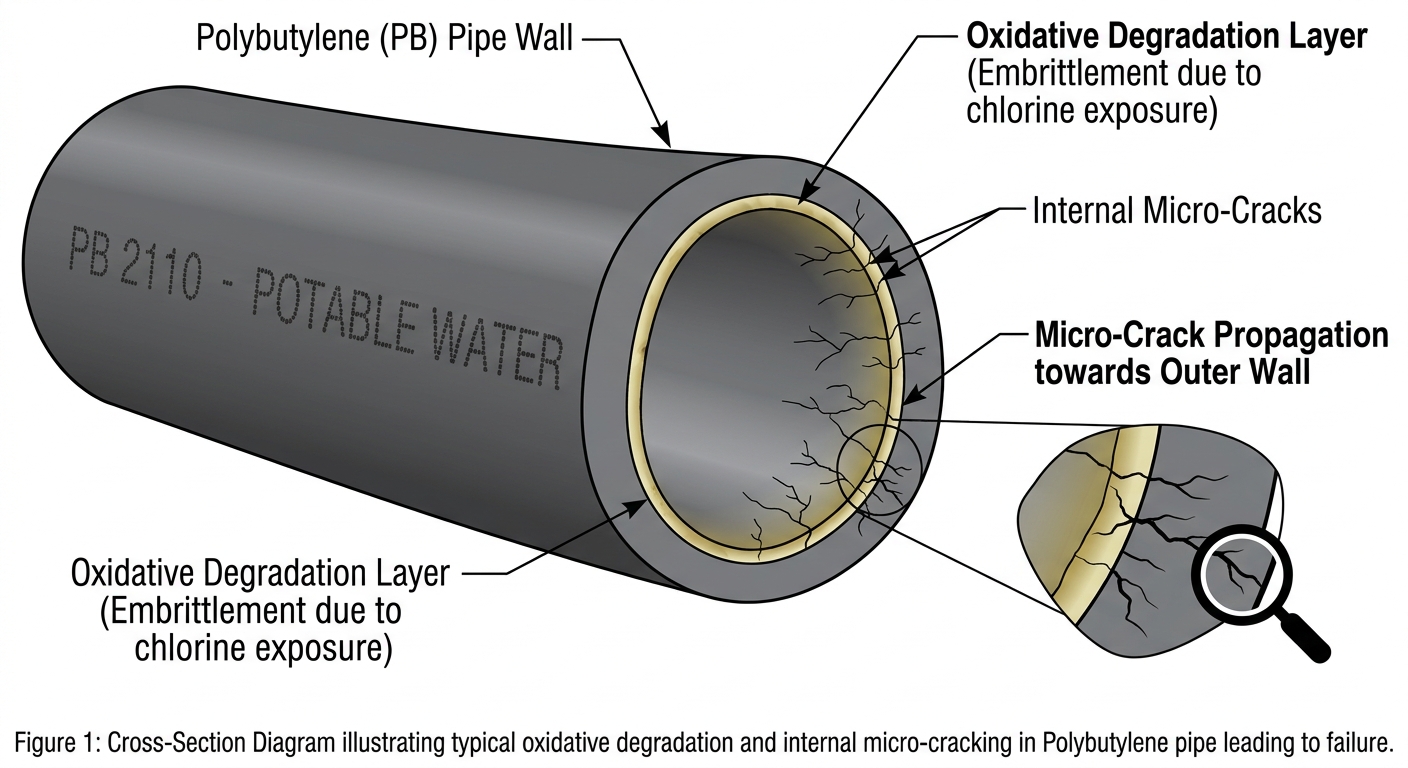
The failure mechanism is oxidation, not simple age or wear. Municipal water suppliers add chlorine or chloramine to disinfect tap water, and both compounds are aggressive oxidizers that attack the tertiary carbon-hydrogen bonds unique to polybutylene’s polymer structure (PM Magazine). Manufacturers built in antioxidant stabilizers to slow this reaction, but those stabilizers are gradually extracted by the very water flowing through the pipe (Polybutylene.ca).
Once the antioxidant package depletes, the inner pipe wall becomes brittle and forms microscopic cracks — classified by ASTM F2023 as a “stage 3” pure oxidative failure marked by multiple through-wall cracks (PM Magazine). Independent laboratory research confirms this: pressure testing showed that even chlorine levels as low as 0.5 ppm meaningfully shortened pipe lifespan, with degradation concentrated in a thin layer on the inner wall (Polymer Degradation and Stability, 2006). Peer-reviewed forensic work on plastic pipe corrosion confirms the same crack-propagation sequence across chlorine, chloramine, and chlorine dioxide disinfectants (Jacobson, Corrosion of Plastic Pipes).
Factors That Accelerate Failure
| Factor | Why it matters |
|---|---|
| Hot water temperature | Heat accelerates both the chemical reaction rate and antioxidant depletion — pipes near water heaters typically fail first (Polybutylene.ca) |
| Chlorine/chloramine concentration | Even low residual disinfectant levels attack tertiary C-H bonds and cause chain scission (Polybutylene.ca) |
| Water pressure | Constant pressurization stresses an already-weakened polymer structure |
| Acetal fitting quality | Gray or white plastic insert fittings are frequently the first failure point, even before the pipe itself cracks (Urban Piping) |
| UV light exposure | Accelerates degradation in any exposed exterior sections of pipe (Polybutylene.ca) |
Warning Signs of an Active or Impending Failure
- Pinhole leaks at fittings or along the pipe wall itself
- White, chalky, calcium-like flaking visible inside any cut or opened pipe section
- Brittleness — the pipe snaps or cracks rather than flexing when handled
- Discolored water or noticeably reduced flow at fixtures
- Weeping wall stains, especially near slab penetrations or below fixtures
- Repeat plumbing service calls in different parts of the same house (RePipe Solutions)
Because failures often begin invisibly inside a wall, a documented history of small leaks in unrelated fixtures is itself a meaningful red flag rather than a coincidence.
The Class-Action Lawsuits That Ended Polybutylene’s Use
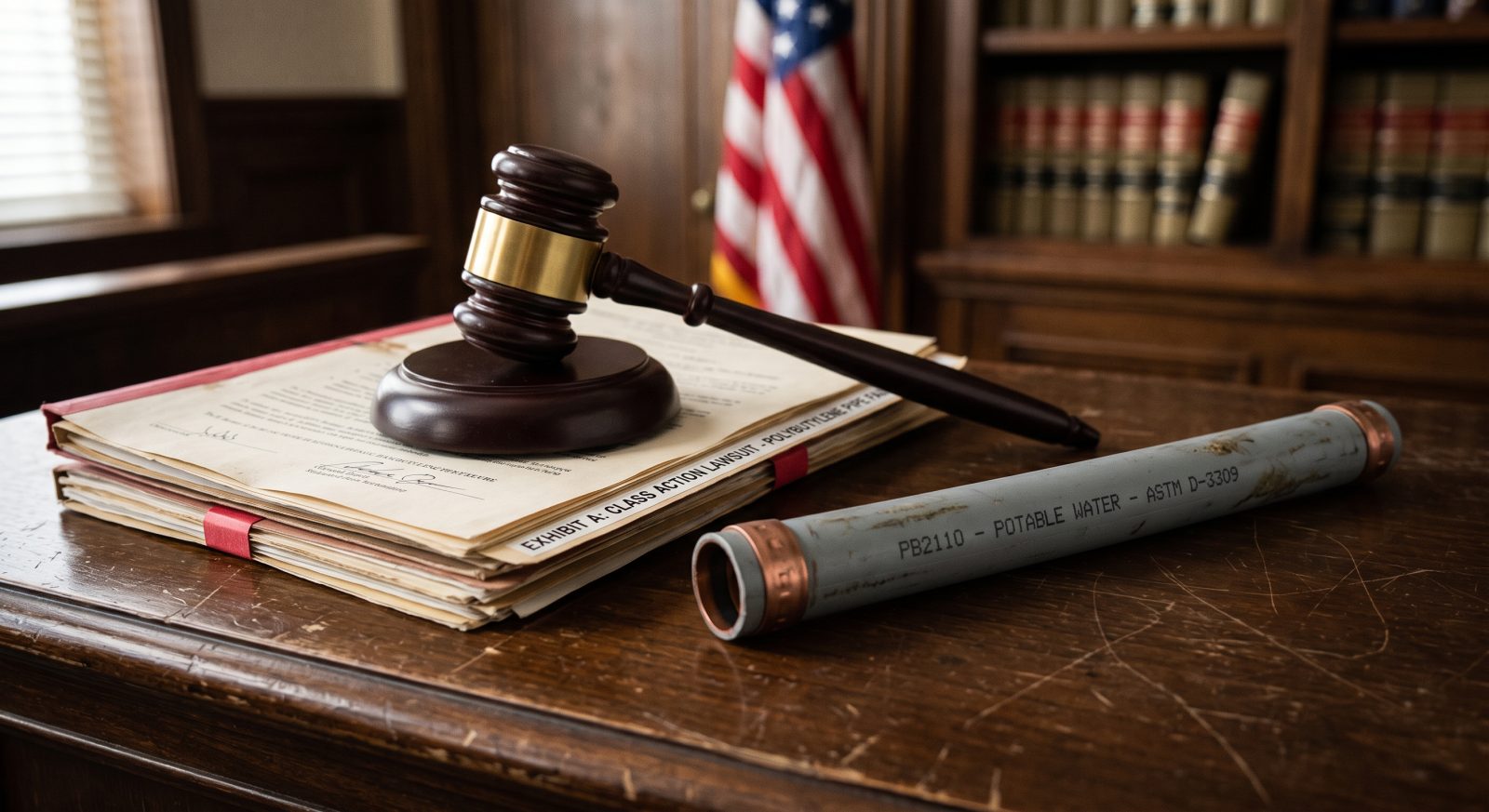
Widespread failures in the early 1990s triggered major litigation. In 1995, homeowners filed Cox v. Shell Oil Co. in Tennessee, which ultimately settled for $950 million and allowed affected homeowners to have their pipes replaced (Modern Castle). A related case, Spencer v. Shell Oil Co., provided an additional $120 million and covered homeowners with polybutylene pipe and acetal fittings even without a confirmed leak (Modern Castle). Delaware’s Superior Court separately addressed resin-supplier liability in S&R Associates v. Shell Oil Co., centering on whether the resin manufacturer bore responsibility for downstream plumbing failures (Justia, Delaware Superior Court). These settlements effectively ended new polybutylene installation across North America by the mid-to-late 1990s.
Why Insurance Often Won’t Cover a Polybutylene Failure
This is the detail that turns identification from a curiosity into a financial priority. A standard HO-3 homeowners policy pays for sudden, accidental water damage — a frozen pipe bursting, a washer hose failing — but it never pays to replace the pipe itself (RePipe Solutions). Following a 2012 State Farm class action, most major carriers responded to the polybutylene risk in one of three ways: attaching an endorsement that excludes any failure stemming from PB pipe, refusing to write new policies on PB-piped homes altogether, or requiring a separate rider with a higher deductible (RePipe Solutions).
In practice, this means a burst polybutylene line in 2026 often is not paid the way a copper burst would be, even for the resulting water damage. A confirmed repipe from PB to PEX or copper generally restores standard coverage on the next policy renewal and removes what is often the single largest exclusion a homeowner faces (RePipe Solutions).
Replacement Cost: What to Budget
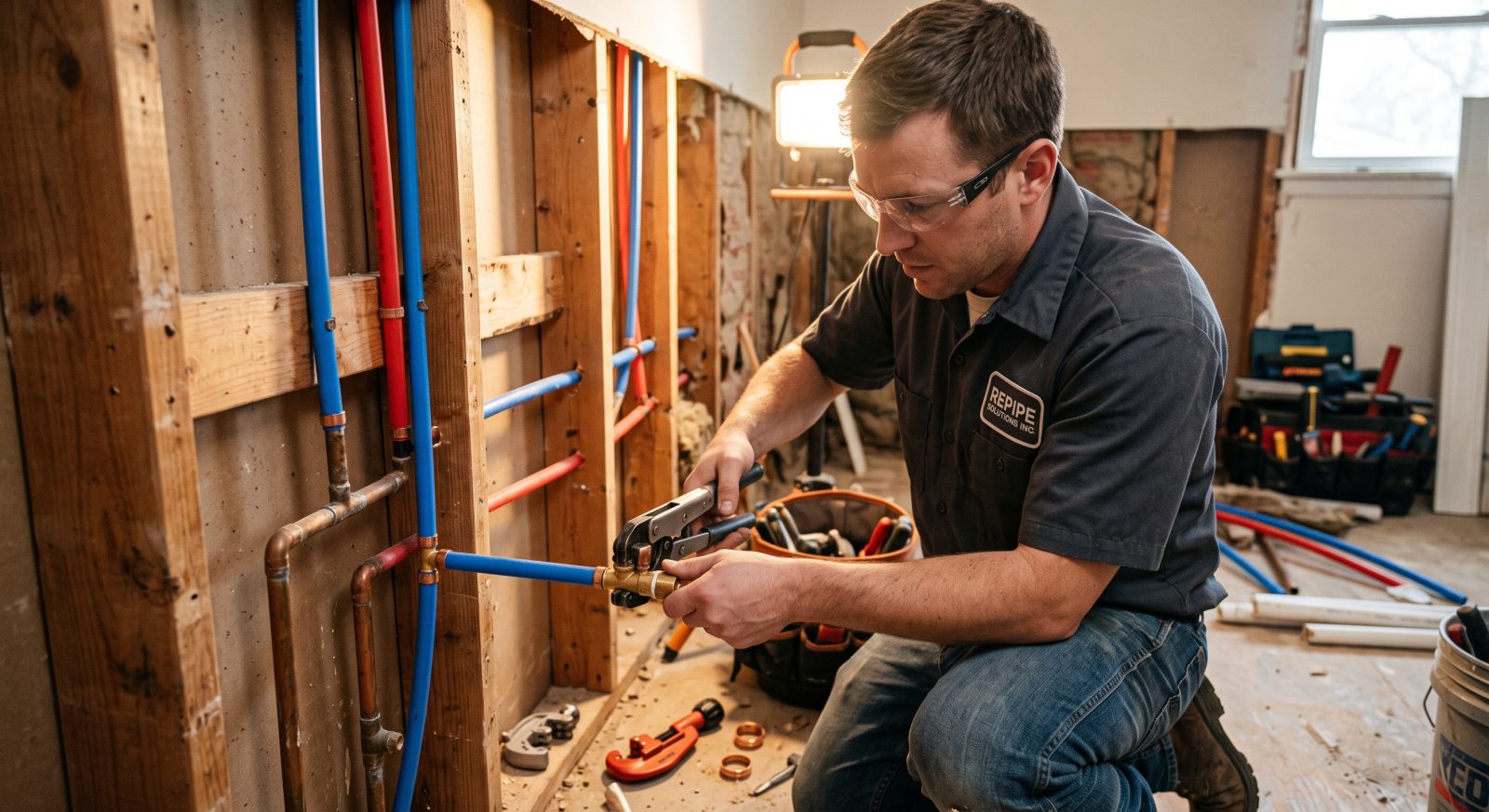
Replacement pricing varies by home size, fixture count, foundation type, and chosen material. Whole-house repipes most commonly fall between $4,000 and $15,000, with a national average near $7,500 to $8,000 (Plumbing Price Guide) (Geek Powered Studios).
| Home size | PEX replacement | Copper replacement |
|---|---|---|
| 1 bathroom (under 1,200 sq ft) | $2,500 – $5,000 | $4,500 – $8,000 |
| 2 bathrooms (1,200 – 1,800 sq ft) | $4,000 – $8,000 | $6,500 – $12,000 |
| 3 bathrooms (1,800 – 2,500 sq ft) | $6,500 – $11,000 | $9,000 – $15,000 |
Source: Plumbing Price Guide, 2026
Labor typically runs $150 to $250 per linear foot depending on pipe accessibility and material choice (Angi). Drywall repair after a repipe is almost always billed separately and can add $1,000 to $3,000 to the total project (Plumbing Price Guide). For comparison, the water damage from an undiscovered leak routinely runs $10,000 to $50,000 or more depending on how long it goes unnoticed (Plumbing Price Guide) — a gap that makes proactive replacement the financially defensible choice over waiting for a failure.
Polybutylene vs. Other Pipe Materials
| Feature | Polybutylene (PB) | PEX | Copper |
|---|---|---|---|
| Typical color | Gray, blue, black, silver, or white | Red, blue, or white | Metallic, shiny |
| Flexibility | Slightly flexible, can be rigid-feeling | Highly flexible | Rigid |
| Stamped marking | “PB2110” or “ASTM D3309” | “PEX” printed along length | No plastic resin stamp |
| Known failure mode | Chlorine-driven oxidative cracking from the inside out (PM Magazine) | Considered chlorine-resistant; different cross-linked polymer structure | Corrosion in aggressive water chemistry, pinhole leaks over decades |
| Insurance treatment | Frequently excluded or riddered (RePipe Solutions) | Standard coverage | Standard coverage |
Frequently Asked Questions
Does the absence of a “PB2110” stamp mean my pipes aren’t polybutylene?
Not necessarily. If your home’s plumbing otherwise matches all the visual and locational criteria for polybutylene, the pipe could still be PB even without a visible stamp, since paint, corrosion products, or installation angle can obscure the print (Square One).
Can polybutylene pipe be repaired instead of replaced?
Individual sections or fittings can sometimes be patched, but because the failure mechanism is systemic oxidative degradation throughout the entire pipe run, a single repair does not address the underlying risk elsewhere in the system — most plumbers recommend a full repipe once PB is confirmed (RePipe Solutions).
Is polybutylene dangerous to health, or just a leak risk?
The documented risk is structural — pipe rupture and water damage — rather than a proven drinking-water toxicity concern; failures are driven by mechanical brittleness and cracking, not chemical leaching into the water supply.
How urgent is replacement if I confirm polybutylene in my home?
Given that failures can happen suddenly and without warning, and that insurance frequently won’t cover the resulting damage, most plumbing professionals recommend scheduling a repipe proactively rather than waiting for the first leak (RePipe Solutions).