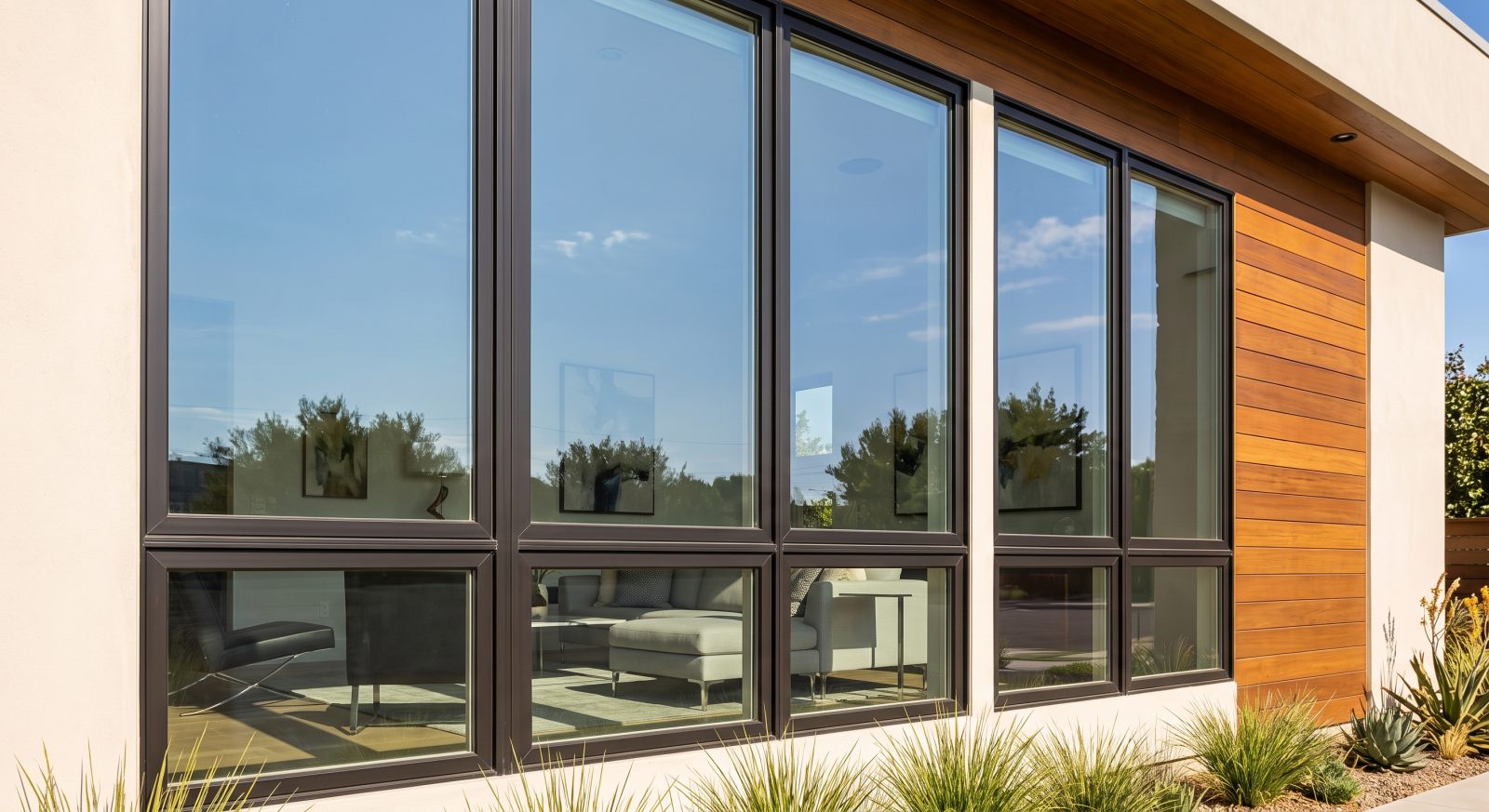
Short answer: South-facing sun can raise glass and edge-seal temperatures, which may worsen the heat-and-moisture stresses behind insulating-glass-unit (IGU) seal failure. But no authoritative field study has established that a properly sealed Low-E coating itself fails faster simply because the window faces south (Lawrence Berkeley National Laboratory). Orientation is a reasonable inspection priority, not a proven cause of coating failure.
If you’ve noticed a hazy or discolored window on the sunniest side of your house, it’s natural to blame the sun directly. This guide walks through what Low-E coatings actually are, how they fail, what the research does and doesn’t support about orientation, and what to check before you assume a west or south wall of windows is doomed.
What “Low-E” Actually Means
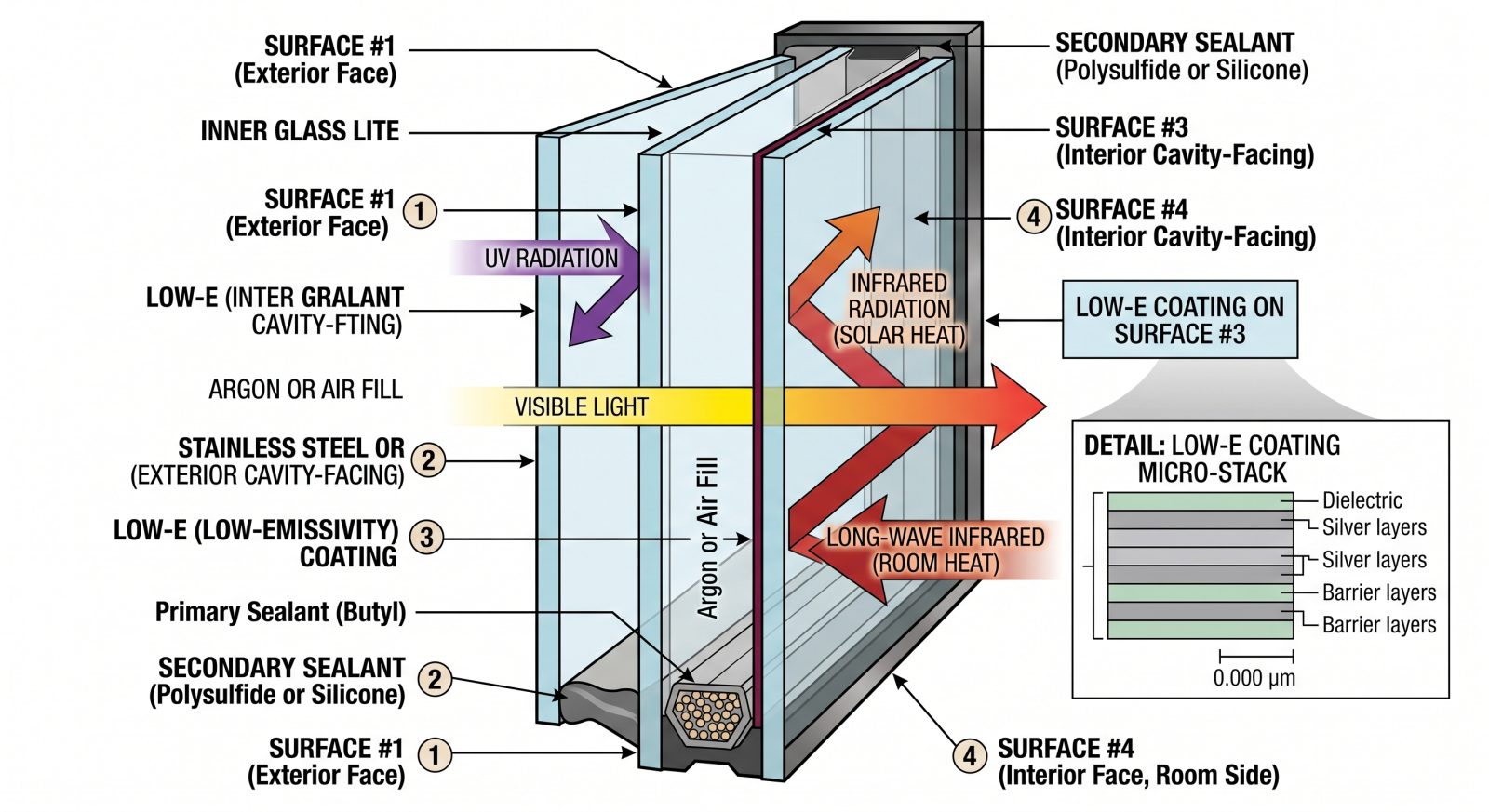
Low-emissivity (Low-E) glass carries a nanoscale coating that reflects mid-infrared heat radiation while staying transparent to visible light. The U.S. Department of Energy notes that Low-E coatings can reduce a window’s energy loss by controlling how much radiant heat passes through the glass, and can cut UV-related fading of furnishings by as much as 75% (DOE Consumer Guide to Energy-Efficient Windows). The National Fenestration Rating Council’s consumer guide states that Low-E coatings can reduce window-associated energy loss by as much as 40% (NFRC / Efficient Windows Collaborative).
Pacific Northwest National Laboratory describes the coating as a multilayer stack of metallic or metal-oxide films only a few atoms thick, engineered to reflect infrared energy without blocking visible light (PNNL technical report). It is not a UV film applied after the fact — it is built into the glass itself, either during manufacturing or in a separate coating chamber.
Hard Coat vs. Soft Coat: Why the Distinction Matters for Durability
| Feature | Pyrolytic (“hard coat”) | Magnetron-sputtered (“soft coat”) |
|---|---|---|
| How it’s applied | Sprayed onto hot float glass on the production line and fused as the glass cools (Guardian Glass) | Deposited in a vacuum chamber onto finished glass, layer by layer (Guardian Glass) |
| Typical structure | Simple metal-oxide layer, usually tin oxide (Pilkington fabrication guide) | Complex stack with one to three ultra-thin silver layers plus protective dielectric layers (2023 environmental-durability review) |
| Handling durability before assembly | Tough; can generally be handled like uncoated glass (Pilkington) | Sensitive to humidity, fingerprints, and exposed edges during storage; manufacturers limit uncoated shelf life to a matter of months (Guardian ClimaGuard User’s Guide) |
| Where it goes in the finished window | Can sometimes be used on an exposed surface where approved | Must face the sealed, dry cavity of the insulating glass unit (Guardian) |
“Soft” does not mean fragile once installed. A sputtered coating sealed correctly inside a dry IGU cavity is isolated from weather and generally does not degrade over the unit’s service life (Springer study on IGU age and reuse potential). The vulnerability shows up only when moisture or corrosive chemicals reach that layer — which is a seal problem, not an inherent coating weakness.
How Low-E Coatings Actually Fail
Silver Corrosion Inside the Coating Stack
The silver layer that gives sputtered Low-E its performance is also chemically reactive once exposed. Laboratory studies document that bare silver reacts with water, oxygen, sulfur compounds, and chlorides — reactions that can cause haze, delamination, or a permanent dark or white cast (2023 environmental-durability review). Manufacturers counter this with protective blocking layers — materials like NiCr, NiTi, or a sacrificial layer of copper built into the nanoscale stack during deposition — but these are factory-engineered barriers, not something a homeowner can add or restore later (2023 environmental-durability review).
Moisture Ingress and Edge-Seal Failure
The IGU perimeter is the weak point. A primary seal blocks moisture and gas transfer; a secondary seal provides structural strength; and a desiccant strip in the spacer absorbs stray moisture until it’s saturated. Once that capacity is exceeded, water vapor condenses inside the cavity, reacts with off-gassed materials to create permanent “chemical fogging,” and can reach the coating itself (LBNL edge-seal review). Cardinal Glass, a major North American Low-E manufacturer, notes that where a glass edge isn’t properly “deleted” (stripped of coating before sealing), corrosion can initiate at that edge and progress inward through the seal (Cardinal edge-deletion bulletin).
Chemical Attack From Cleaning and Masonry Work
Chloride exposure is a documented risk factor independent of sun exposure. Vitro Architectural Glass warns that chlorine and chloride compounds can attack exposed silver in coatings that weren’t properly edge-deleted (Vitro edge-deletion technical document). Guardian Glass separately found higher IGU failure rates linked to acidic “brick wash” masonry cleaners containing hydrochloric or hydrofluoric acid coming into contact with Low-E glass during construction or renovation (Guardian ClimaGuard User’s Guide).
Thermal Cycling and Mechanical Stress
Sun heats the center of a windowpane faster than its shaded, frame-covered edges, putting the cooler perimeter under tension. Vitro’s engineering guidance treats this as a glass-breakage risk rather than a coating-corrosion risk, and recommends design review when its models predict more than eight thermal-stress breaks per 1,000 units (Vitro thermal-stress guidance). Repeated daily and seasonal temperature swings also flex the edge seal itself. LBNL’s technical review describes the combination of heat, water, and sunlight acting together as the single greatest stress on an IGU edge seal (LBNL edge-seal review) — but that’s a description of a stress combination, not proof that south exposure alone determines the outcome.
Why Sun-Facing Windows Get More Exposure — and Why That’s More Nuanced Than It Sounds
In the Northern Hemisphere, the U.S. Department of Energy’s passive-solar design guidance recommends orienting glazing within 30 degrees of true south specifically because that exposure captures low winter sun through the middle of the day (DOE Consumer Guide to Passive Solar Home Design). The National Renewable Energy Laboratory has published detailed incident solar-radiation data for vertical north-, south-, east-, and west-facing windows across 239 U.S. weather stations, confirming that solar dose varies by latitude, season, and station — not by a single national rule (NREL Solar Radiation Data Manual for Buildings). In the Southern Hemisphere, the equivalent equator-facing orientation is north: Australia’s government building guide notes that north-facing rooms receive winter sun for the longest period of the day (Australian Government Your Home guide).
South-Facing vs. West-Facing: Not the Same Kind of Exposure
It’s a common assumption that the equator-facing wall of a house is always the hottest, but that isn’t necessarily true. A vertical south-facing window can often be shaded efficiently by a properly sized overhang because the summer sun sits high overhead at midday. West-facing (and to a lesser extent east-facing) glass frequently receives the more punishing exposure, because low-angle afternoon sun in hot climates hits unshaded west glazing directly and drives up interior heat gain later in the day, when outdoor temperatures are already at their peak (PNNL Building America Solution Center). In practice, west-facing windows in warm climates can experience more cumulative thermal stress over a summer than south-facing ones, even though “south-facing” gets more attention in casual conversation. Actual glass temperature depends on latitude, season, cloud cover, shading, interior blinds, and glass color — not compass direction in isolation (NREL Solar Radiation Data Manual).
What the Field Evidence Actually Shows
This is where a lot of home-improvement content overstates the case. Here is what the available research actually supports:
| Evidence source | What it found | What it does and doesn’t prove |
|---|---|---|
| Historical Norwegian field investigation | Investigators specifically looked for a difference between north-facing windows and sun-facing windows and “were not able to prove any difference” (NIST/NBS durability seminar proceedings) | Directly cautions against a blanket orientation claim, though it predates modern silver-based Low-E coatings |
| IGMA 25-Year Field Correlation Study | Tracked roughly 2,400 IGUs across 140 buildings and 14 climate areas; found 1.2% failure at 10 years and 3.6% at 25 years for its best-performing construction class (IGMA 25-Year Field Correlation Study) | Strongest long-term field dataset available, but does not break results down by compass orientation or isolate Low-E coatings specifically |
| Same IGMA study, installation findings | 60% of field failures were accelerated by glazing systems that held water at or near the edge seal; units with drained/wet-glazed exteriors had roughly one-tenth the failure rate of dry-glazed exteriors (IGMA study) | Strong evidence that drainage and installation quality matter far more than orientation alone |
| 2023 peer-reviewed environmental-durability review | Found limited research on whether Low-E optical properties persist over a window’s full service life, and no published residential failure rates broken down by orientation (2023 review, Solar Energy Materials and Solar Cells) | Confirms a genuine research gap; lab corrosion tests cannot be converted directly into a years-on-a-house estimate |
| Manufacturer warranties (Guardian, Cardinal) | Guardian offers a 10-year coating warranty; Cardinal advertises a 20-year, 150% credit warranty and reports a 0.2% failure rate over 20 years for one edge-seal system (Guardian limited warranty) (Cardinal XL Edge) | Neither warranty shortens coverage based on compass orientation, which reflects manufacturer confidence across all typical installations |
The Realistic Failure Chain
Putting the mechanisms and evidence together, the defensible chain of causation looks like this:
- More direct sun can raise glass and edge-seal temperatures and increase daily thermal cycling.
- Heat, moisture, and sunlight acting together place the greatest combined stress on an IGU edge seal (LBNL).
- If the seal is inadequate — due to poor drainage, incompatible sealants, insufficient edge deletion, or chemical exposure — moisture or reactive compounds can reach the coating.
- Once exposed, the silver layer can corrode, discolor, or delaminate.
What’s missing from that chain, based on current evidence, is proof that step 1 alone — simply facing south — reliably triggers steps 2 through 4 in a properly manufactured and installed window. The stronger predictors of failure are seal quality, edge deletion, drainage, and chemical exposure, not compass direction by itself.
Signs of Coating or Seal Failure
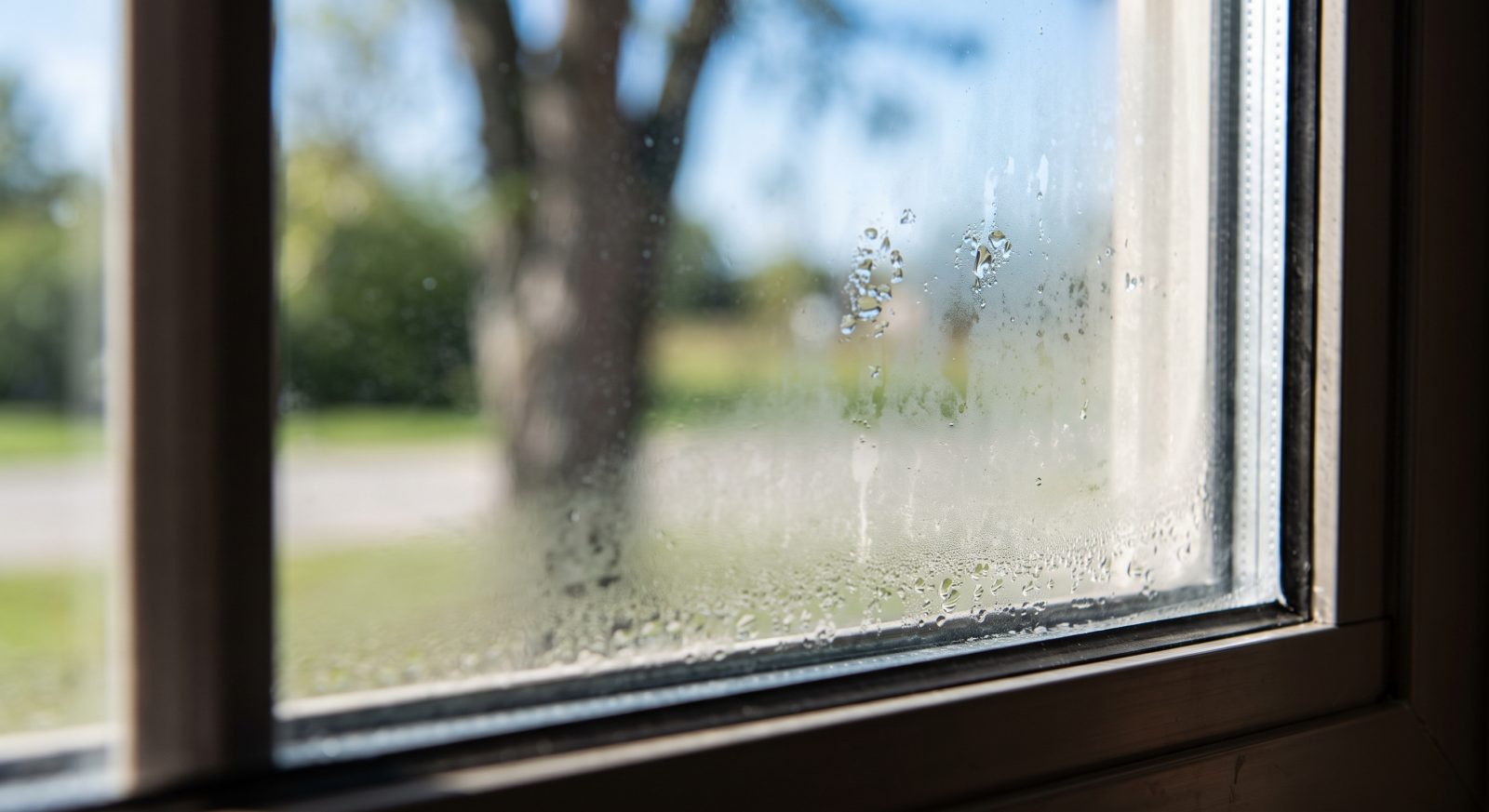
Reliable Signs of a Failed Sealed Unit
- Condensation, fog, or dirt trapped between the panes — the clearest, most reliable indicator of a broken hermetic seal (IGMA study)
- A permanent cloudy or opaque film that doesn’t wipe away from either accessible glass surface, often called “chemical fogging” (LBNL edge-seal review)
- Corrosion or discoloration that starts at the edge of the glass and spreads inward, suggesting moisture has breached the seal (Cardinal bulletin)
Common False Positives
| What you might see | What it usually means |
|---|---|
| A subtle rainbow, bronze, blue, or purple tint that shifts with viewing angle | Normal optical behavior of coated or tempered glass — not automatically a sign of failure |
| Condensation on the room side of the glass | Usually indicates high indoor humidity against a cold glass surface, not a broken seal |
| Condensation on the outside of the glass in the early morning | Can actually indicate good insulation — the outer pane stays colder because heat isn’t escaping through it |
| Hazy film that wipes off | Hard-water deposits, dirt, or residue — not internal coating damage |
Treat a tint or haze as suspicious only when it is new, spreading, clearly originating at the edge, or inconsistent between otherwise matching windows on the same wall. When in doubt, have a glazier confirm the diagnosis before assuming the coating has failed.
Factors That Actually Accelerate Failure
| Factor | Why it matters |
|---|---|
| Edge-seal and spacer quality | Primary seal geometry controls moisture diffusion; secondary seal provides structural adhesion. Poor combinations correlate strongly with early field failure (LBNL) |
| Edge deletion | Removing coating material under the seal line interrupts the corrosion pathway into the cavity — a factory process, not something retrofittable (Vitro) |
| Installation and drainage | The IGMA field study found 60% of failures were accelerated by systems that held water near the edge seal (IGMA study) |
| Cleaning chemicals | Masonry acids, alkaline cleaners, and abrasive tools can damage both sealants and exposed coating edges (Guardian) |
| Climate and humidity | Hot, humid, or high-UV climates place more combined stress on seals over time, though no formula converts this into a precise “years lost” figure (NREL) |
| Orientation and shading | A risk modifier worth factoring into inspection frequency — not a proven standalone cause of coating failure |
Prevention: Getting the Coating Placement and Seal Right
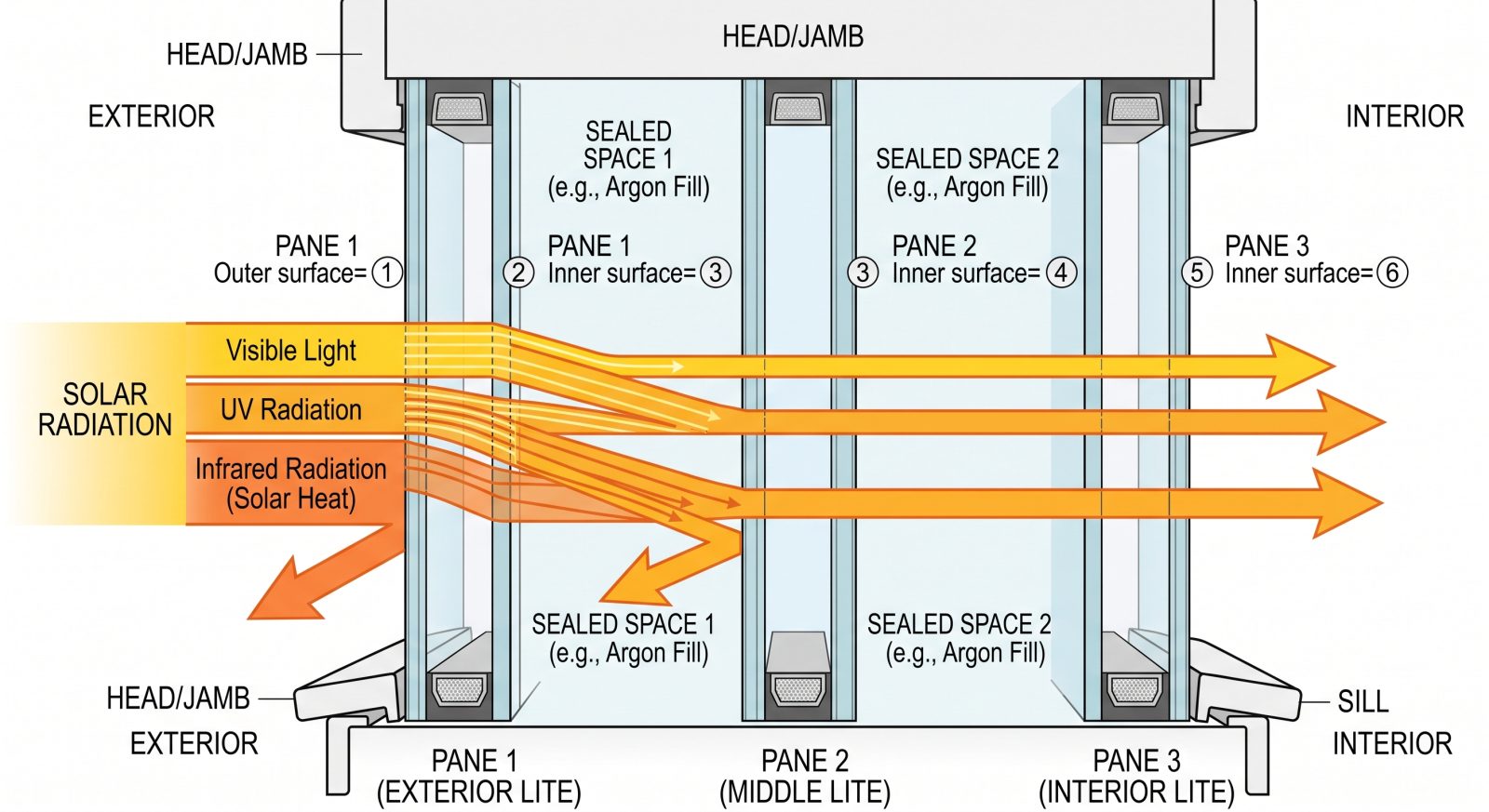
In a double-pane IGU, surfaces are numbered from outdoors to indoors: Surface #1 is the outer face of the exterior lite, #2 is its cavity-facing side, #3 is the cavity-facing side of the interior lite, and #4 is the room-side face. Most sputtered Low-E coatings belong on surface #2 or #3, always facing the sealed, dry cavity rather than the exterior or interior air. Surface #2 generally reduces solar heat gain more, which suits hot, sun-exposed elevations, while surface #3 can admit more beneficial winter solar gain in heating-dominated climates (Syracuse Glass orientation guide). This is a decision your window manufacturer makes at the specification stage — homeowners can’t move a coating after the fact, but it’s worth asking your installer which surface the coating sits on for large, sun-exposed openings.
Practical Steps for Homeowners
- Ask for the whole-window NFRC rating (U-factor, solar heat gain coefficient, visible transmittance) rather than just a coating brand name when replacing windows (PNNL guide)
- Confirm the IGU is certified to ASTM E2190 for long-term seal durability (IGMA study)
- Keep weep holes and sill drainage paths clear so water doesn’t sit against the bottom edge seal
- Use only manufacturer-approved, non-abrasive cleaning methods — mild neutral detergent, water, and a soft cloth or squeegee (Pilkington)
- Keep masonry acids, alkaline cleaners, and pressure-washer spray away from window edges during renovation work
- Add exterior shading, such as a properly sized overhang, on strongly sun-exposed elevations — this reduces heat load without altering the coating itself (DOE passive-solar guide)
Repair vs. Full Replacement
A corroded or fogged Low-E coating inside a sealed cavity cannot be cleaned, recoated, or repaired in place — the sealed glass unit itself has to be replaced (This Old House cost guide). “Defogging” services that drill a hole and dry out the cavity can temporarily improve appearance, but they do not restore the desiccant capacity, the gas fill, or the original hermetic seal — treat this as a cosmetic fix, not an equivalent to a new certified IGU.
| Repair type | Typical cost range |
|---|---|
| Low-E glass replacement | $350–$840 (average ~$595) (This Old House) |
| Standard double-pane IGU replacement | $150–$600 (average ~$375) (This Old House) |
| Triple-pane IGU replacement | $400–$950 (average ~$675) (This Old House) |
| Glazier labor | $50–$125 per hour (This Old House) |
Full window replacement (frame and all) makes more sense than an IGU-only swap when the sash or frame is rotted, warped, chronically leaking, or otherwise unable to properly retain a new sealed unit.
What Your Warranty Actually Covers
It’s worth being clear about whose warranty applies. Glass manufacturers like Guardian and Cardinal issue coating and seal warranties to their direct customers — typically the window fabricator, not the homeowner (Guardian limited warranty). As a homeowner, your actual coverage comes from the window manufacturer or installer who sold and fitted the finished window, and that warranty’s terms, transfer provisions, and labor coverage — not the upstream glass-coater’s warranty — determine what’s covered if a coating or seal fails. Keep your purchase paperwork, serial number, and installer contract; you’ll need them to file any claim.
Homeowner Inspection Checklist
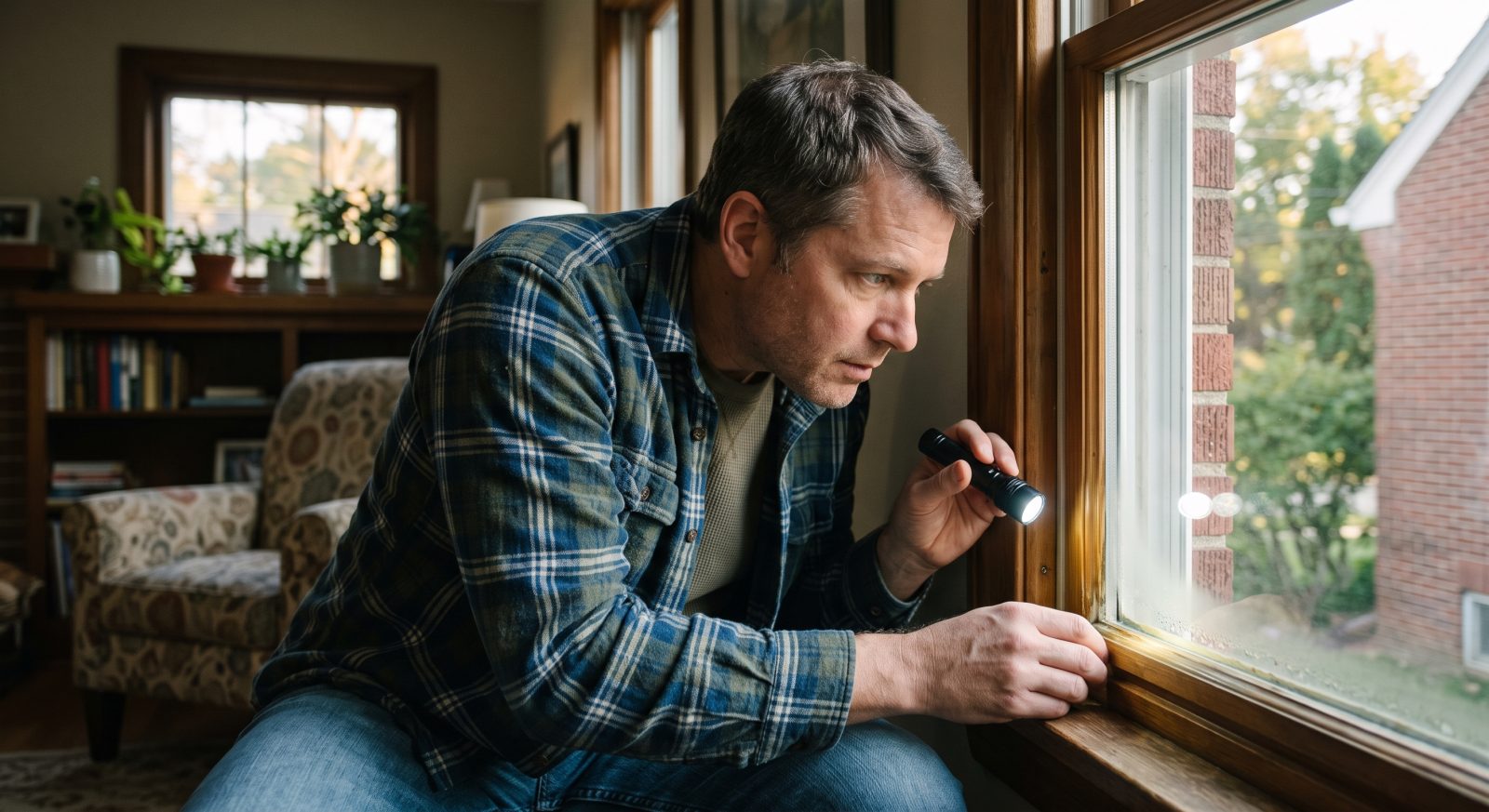
- Inspect the glass in diffuse daylight, comparing similar-sized windows on the same wall side by side.
- Clean both accessible surfaces with an approved non-abrasive method; if haze remains, it may be inside the sealed cavity.
- Check the perimeter first — edge staining, spreading discoloration, or metallic-looking corrosion is more concerning than a uniform tint across the whole pane.
- Look for between-pane moisture after a cool night or humid stretch of weather.
- Check that weep holes are open and there’s no standing water at the sill.
- Note which direction the window faces, how many hours of direct sun it gets, and whether comparable windows on other elevations show the same issue.
- Locate your window’s label or paperwork — manufacturer, series, approximate install date — before calling for service.
When to Call a Professional
Contact a glazier or window service technician if you see condensation trapped between panes, corrosion starting at a glass edge, a color change that spreads over time, or if multiple windows on the same wall fail around the same time (which points to a systemic drainage or installation issue rather than an isolated defect).
How Long Should Low-E Glass Actually Last?
Properly manufactured, glazed, and installed dual-sealed IGUs have documented service lives exceeding 25 years, and one peer-reviewed study describes a general technical expectation of 30 to 40 years for insulating glass units under normal conditions (Springer in-situ study). The IGMA field study found only a 3.6% adjusted failure rate at 25 years for its best-performing construction class (IGMA study).
No credible source publishes a separate expected lifespan for south-facing versus north-facing Low-E windows, and this article won’t invent one. A fair takeaway: expect multiple decades of service from a well-made, well-drained, correctly installed window regardless of orientation, but start inspecting earlier — and more often — on elevations with heavy, unshaded direct sun exposure.
Myths About South-Facing Low-E Windows
| Myth | Reality |
|---|---|
| South-facing Low-E coatings always fail faster | Mechanistically plausible through added heat/moisture stress, but not established as a proven, direct field outcome |
| UV light directly destroys the silver coating | UV mainly degrades organic seals and sealants; silver degradation is more directly linked to moisture, oxygen, sulfur, and chloride exposure |
| South is always the hottest side of the house | Not universally true — unshaded west-facing glass often takes a harsher afternoon heat load in hot climates |
| A rainbow or bronze tint proves the coating failed | Often just normal optical behavior from coating layers, tempered glass, or viewing angle |
| Soft-coat Low-E is inherently short-lived | True only if mishandled or exposed; correctly sealed soft coat can last the life of the IGU |
Frequently Asked Questions
Does facing south shorten a window’s lifespan?
Not by itself. Orientation can add to the heat and moisture stress on an IGU’s edge seal, but properly manufactured and installed windows have not been shown to fail specifically because they face south (LBNL).
Is a colored tint on my window a sign of failure?
Not automatically. Multiple reflections, viewing angle, and heat treatment can all cause a normal color shift in coated glass. Focus on whether the tint is new, spreading, or starting at the edge before assuming failure.
Can a fogged Low-E window be repaired instead of replaced?
The sealed glass unit itself generally needs full replacement once moisture or corrosion gets inside; “defogging” is a temporary cosmetic fix, not a true repair (This Old House).
Which is worse for windows — south or west exposure?
It depends on climate and shading, but in many hot climates, unshaded west-facing windows take a harsher heat load from low-angle afternoon sun than south-facing windows, which can often be shaded by a properly sized overhang (PNNL).