If you’re still living with original single-pane glass, you’re paying a hidden annual tax on every heating bill — and in many climates, that tax adds up to more than the replacement itself would cost over a few winters. This article breaks down the real numbers behind single-pane heat loss, walks through the U-factor math that drives those losses, and shows how to calculate your own payback period before calling a contractor.
Why Single-Pane Glass Is Effectively “a Hole in the Wall”
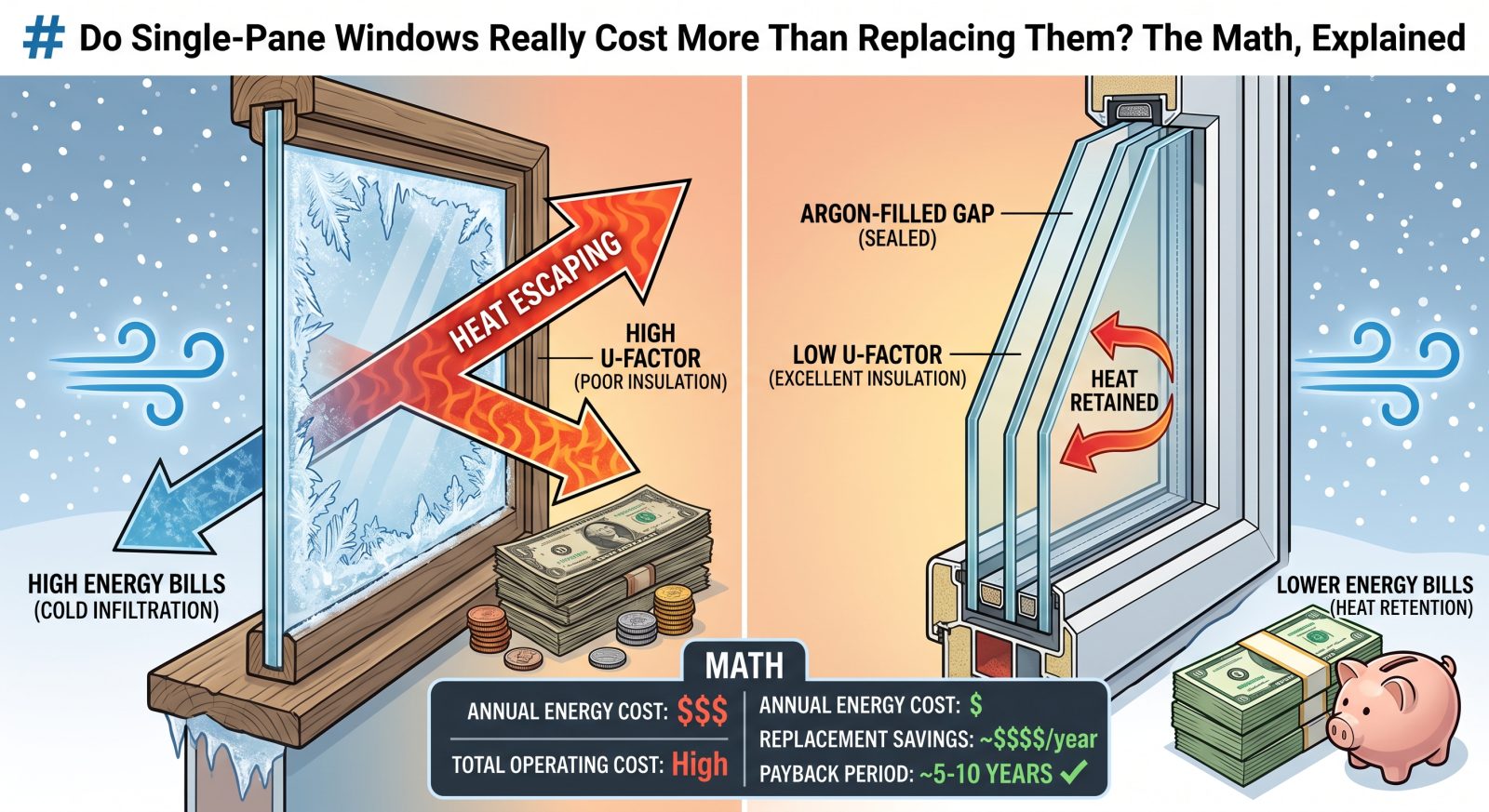
Single-pane windows carry a U-factor — the rate of heat transfer through a window assembly — of roughly 0.9 to 1.3, compared with 0.25 to 0.50 for a quality double-pane unit (source, source). Because U-factor is the inverse of R-value, that single layer of glass provides only about R-1 of insulation, versus R-3 to R-4 for an argon-filled, Low-E double-pane replacement (source, source). In practical terms, a single-pane window loses heat roughly two to four times faster than a standard energy-efficient replacement (source), and some assessments describe single-pane glass as losing heat 10 to 15 times faster than an insulated wall cavity (source).
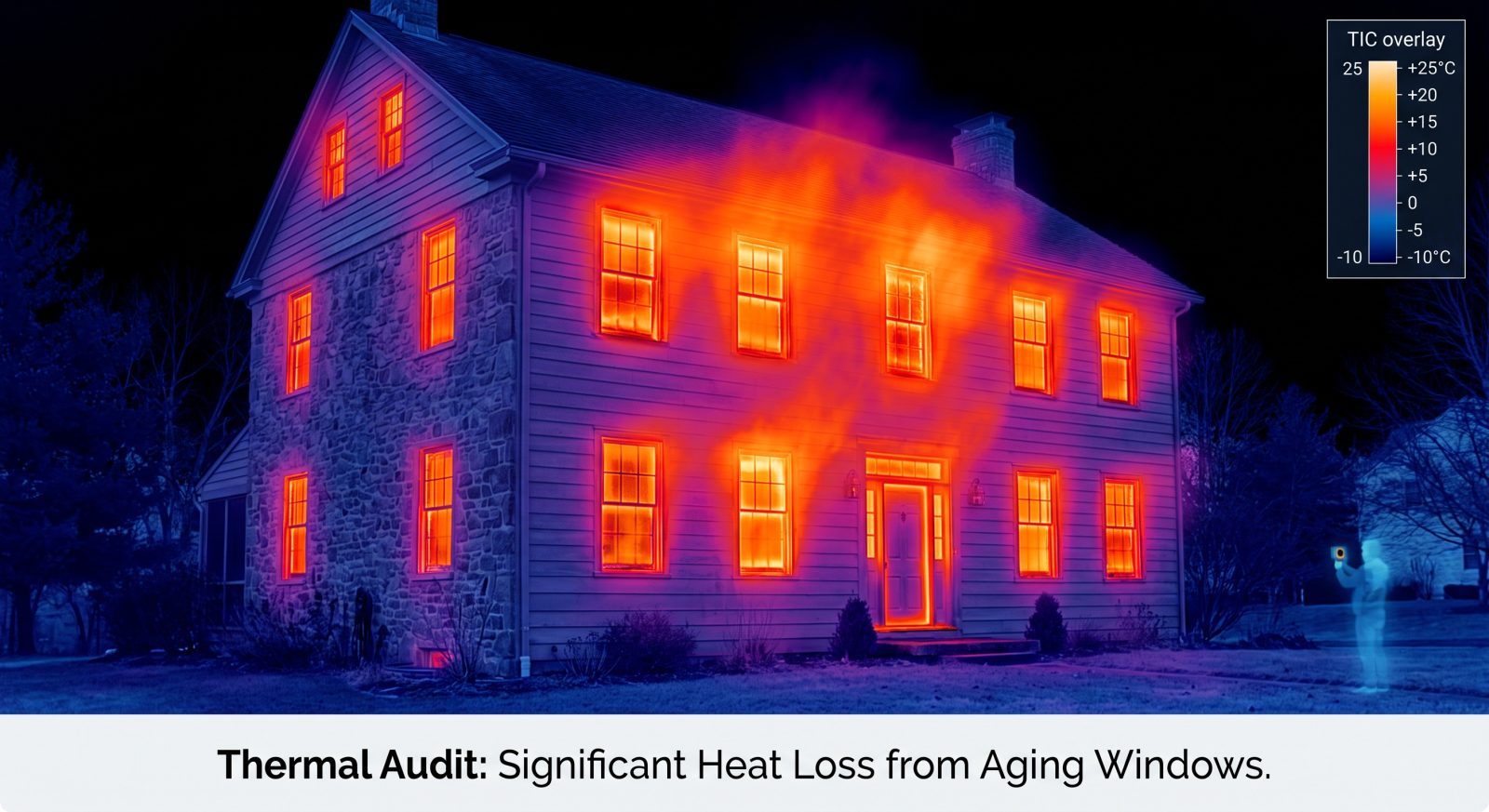
This matters at scale because windows, doors, and skylights account for an estimated 25 to 35 percent of total residential heat loss according to national energy agencies, with some homes exceeding 40 percent when aluminum frames or failed seals are involved (source, source). A Penn State analysis similarly found that windows account for around 18 percent of a building’s total heat loss despite covering only 15 to 20 percent of exterior wall area — a disproportionate share driven almost entirely by poor glazing performance (source).
What Single-Pane Heat Loss Actually Costs Per Year
The U.S. Department of Energy and ENERGY STAR program estimate that replacing single-pane windows with certified high-efficiency models saves homeowners between $101 and $583 annually, depending on climate zone, home size, and local utility rates (source, source). Other regional breakdowns push that range even further: a household spending $2,500 a year on heating in a cold climate could see $375 to $625 in annual savings after a single-pane-to-efficient upgrade, since windows are responsible for 25 to 35 percent of that heat loss (source).
Per-window estimates are similarly consistent across sources. Older analyses attribute roughly $60 to $120 in annual heat-loss cost to each poorly performing single-pane window in cold climates, and $8 to $15 even in milder ones (source). A separate cost-per-window breakdown found that upgrading from single pane to a Low-E double-pane unit saves $21 to $33 per window annually, while jumping to Low-E triple-pane pushes that to $27 to $40 per window per year (source).
| Upgrade Path | Typical U-Factor (After) | Estimated Annual Savings |
|---|---|---|
| Single pane → double pane, clear | 0.45–0.55 | $175–$275/year (whole home) |
| Single pane → double pane, Low-E | 0.25–0.35 | $250–$400/year (whole home) |
| Single pane → triple pane, Low-E | 0.15–0.24 | $325–$475/year (whole home) |
| Single pane → insulated glass (DMV region) | 0.25–0.30 | $200–$750/year |
These figures also compound with regional heating intensity. In Utah’s climate, homeowners with older single-pane windows report window-related energy losses of $600 to $1,440 a year out of total heating and cooling bills of $2,400 to $4,800 (source). In Colorado, replacing single-pane glass with modern double-pane Low-E units cuts heating costs by 25 to 35 percent, translating to $300 to $420 saved over a typical six-month heating season alone (source).
Replacement Cost vs. Annual Loss: Running the Payback Math
Installed single-pane replacement windows typically run $150 to $400 per window, while a standard double-pane unit with Low-E coating and gas fill costs $400 to $1,250 installed, depending on size, frame material, and glazing package (source, source). The incremental cost of upgrading — the number that actually matters for payback — is the difference between those figures, not the full replacement price, since the old windows would eventually need replacing regardless.
The formula is straightforward:
Payback (years) = Incremental Window Cost ÷ Annual Energy Savings
Using typical figures — an incremental cost of roughly $250 to $600 per window for upgrading to Low-E double pane, against $21 to $40 in annual per-window savings — payback lands between roughly 6 and 20 years depending on climate and orientation (source, source). Whole-home paybacks calculated in cost studies land in a similar 10 to 20-year range for single-pane-to-double-pane-Low-E upgrades, which is considered a “strong financial case” compared with more marginal double-to-triple-pane upgrades that often take 25 to 40 years to pay back (source, source).
This is the key distinction the article’s title math depends on: for windows that are still genuinely single-pane, the annual heat-loss cost is high enough that many homeowners recover the incremental replacement cost within a single decade, and some replace the equivalent of the entire installed cost in cumulative heating savings within the 15 to 25-year service life of the new glass (source, source). For homes that already have older double-pane windows, by contrast, the case is weaker — payback stretches to 25 to 40 years because the starting U-factor is already much lower (source).
U-Factor Reference Table
| Window Type | Typical U-Factor | Approx. R-Value | Relative Performance |
|---|---|---|---|
| Single pane, no coating | 0.90–1.30 | ~R-1 | Baseline; highest heat loss |
| Double pane, air-filled | 0.47–0.55 | ~R-2 | ~40–50% better than single |
| Double pane, Low-E + argon | 0.25–0.35 | ~R-3.3–R-4 | ~70–75% better than single |
| Triple pane, Low-E + krypton | 0.15–0.24 | ~R-4.5–R-7 | Best available; marginal gain over double-Low-E |
Regional and Structural Factors That Change the Math
Climate zone drives the size of the annual savings figure more than almost any other variable — the same single-pane window in a mild coastal region might waste $8 to $15 a year, while an identical window in a cold northern climate wastes $60 to $120 a year (source). Home size, number of windows, orientation (south- and west-facing glass loses more in winter but gains more solar heat), and shading all shift the total further, which is why national averages span such a wide $101 to $583 range (source).
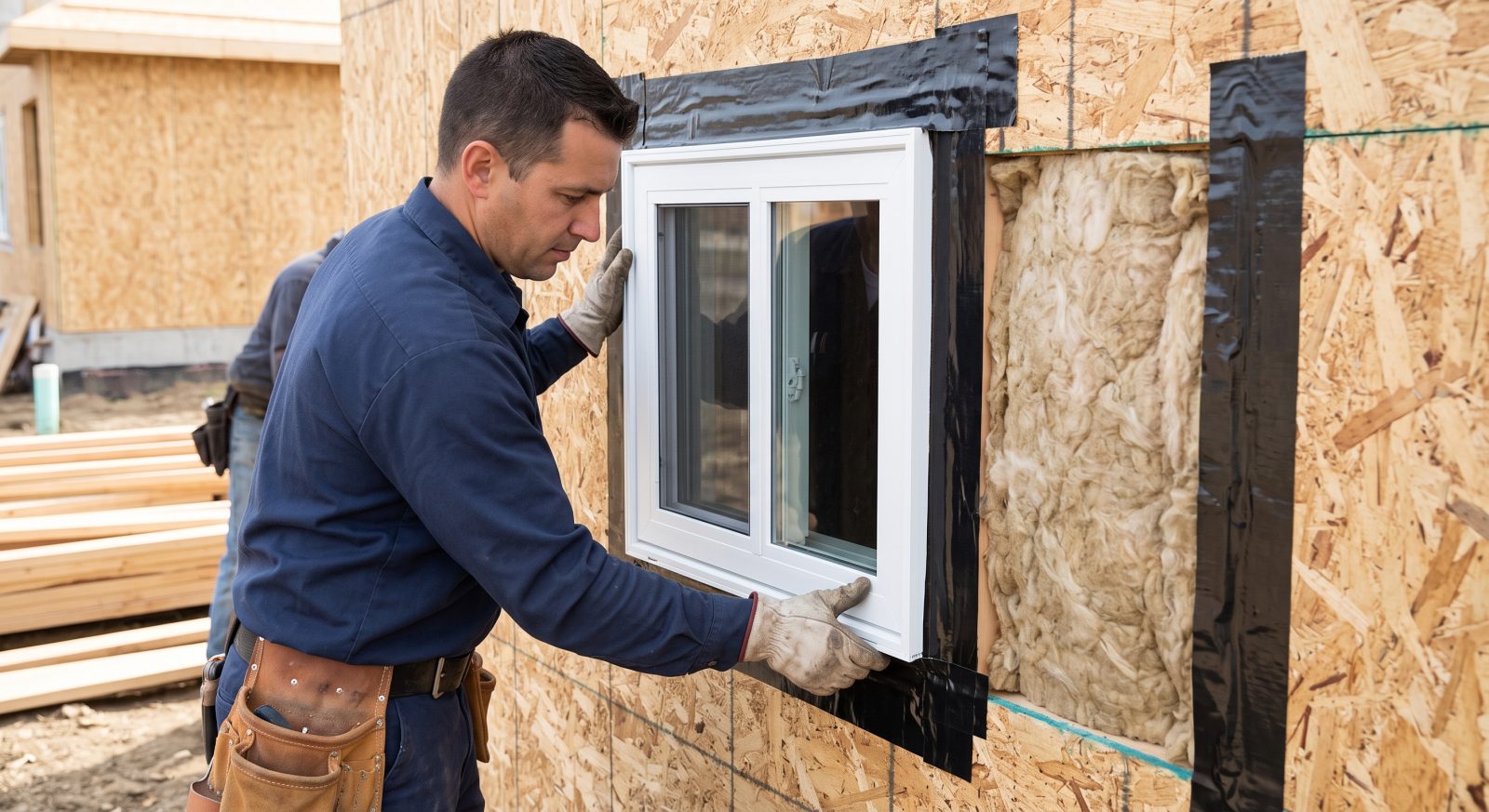
Frame material and installation quality also matter independently of the glass itself. A properly air-sealed double-pane retrofit will outperform a poorly installed one with the same U-factor rating, since air infiltration around the frame — not just conductive loss through the glass — contributes significantly to total window-related heat loss (source). Homeowners evaluating quotes should ask installers for the NFRC-labeled U-factor and confirm proper flashing and insulation around the rough opening, since installation defects can erase a portion of the efficiency gains the new glass promises (source).
Practical Takeaway for Homeowners Comparing Costs
For a home still fitted with original single-pane glass, the annual heating-loss cost attributable to those windows frequently exceeds $200 to $600 depending on climate and window count, while the incremental cost of upgrading to a Low-E double-pane replacement often falls in a comparable or lower range once amortized over the window’s service life (source, source, source). That makes single-pane replacement one of the more financially defensible home-efficiency upgrades available, in contrast to double-to-triple-pane upgrades, which typically save far less per dollar spent (source, source).