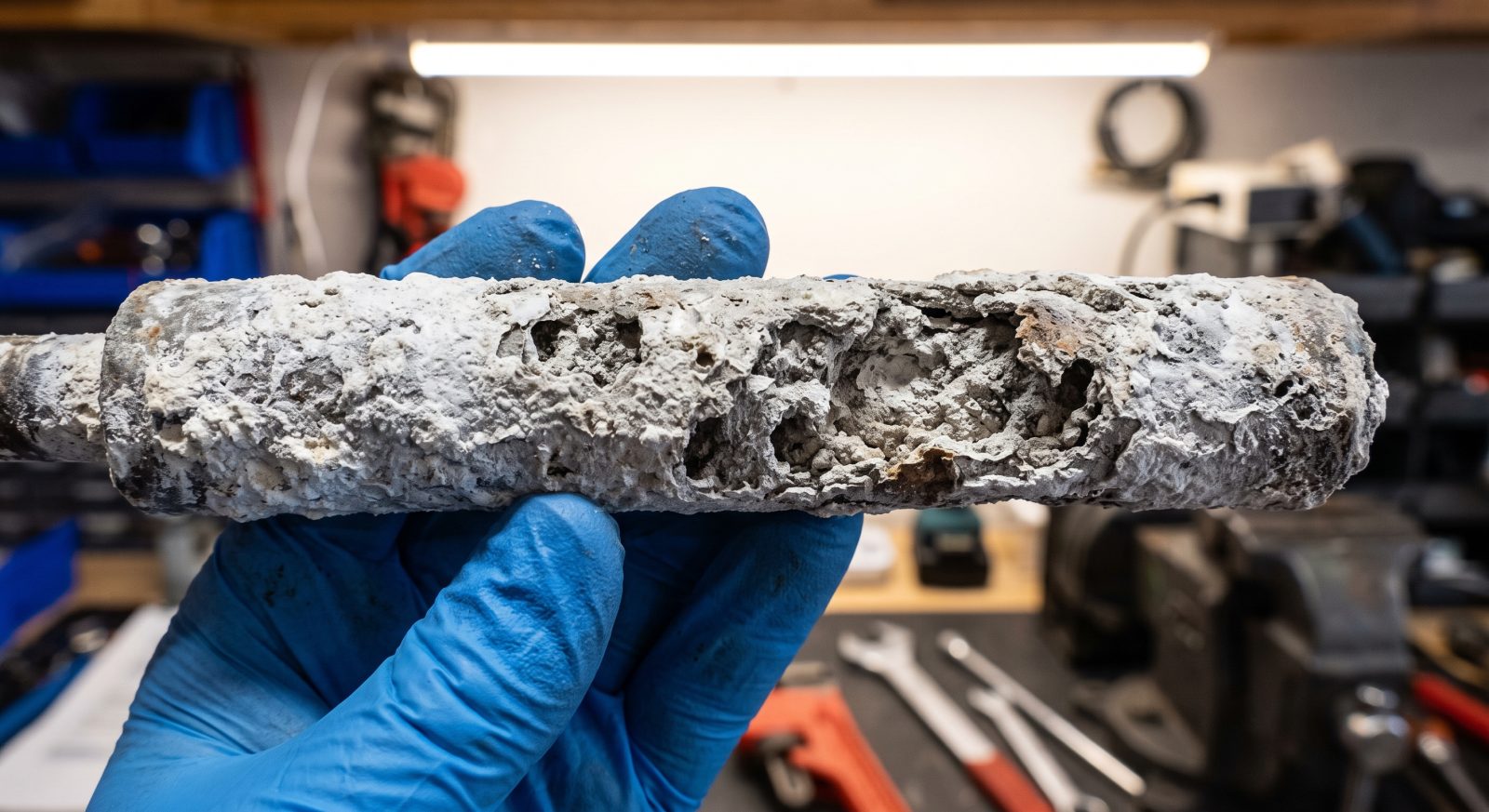
Short answer: Yes — but the three-year mark is not a magic deadline, it’s a realistic worst-case timeline. A magnesium anode rod in soft, high-temperature municipal water can be fully consumed in as little as one to two years, and once it’s gone, the steel tank itself becomes the next thing the water attacks (WaterHeaterChecker.com). In hard water or low-use situations, that same rod might last five to eight years before depletion, which means “three years” isn’t a universal rule — it’s the point by which most homeowners should have already inspected the rod at least once (Water Heater Anode Rod Replacement Guide).
This guide breaks down the electrochemistry behind why the rod fails first, how fast tank corrosion actually progresses once it’s gone, and what a realistic inspection and replacement schedule looks like for different water conditions.
Why the Anode Rod Corrodes on Purpose
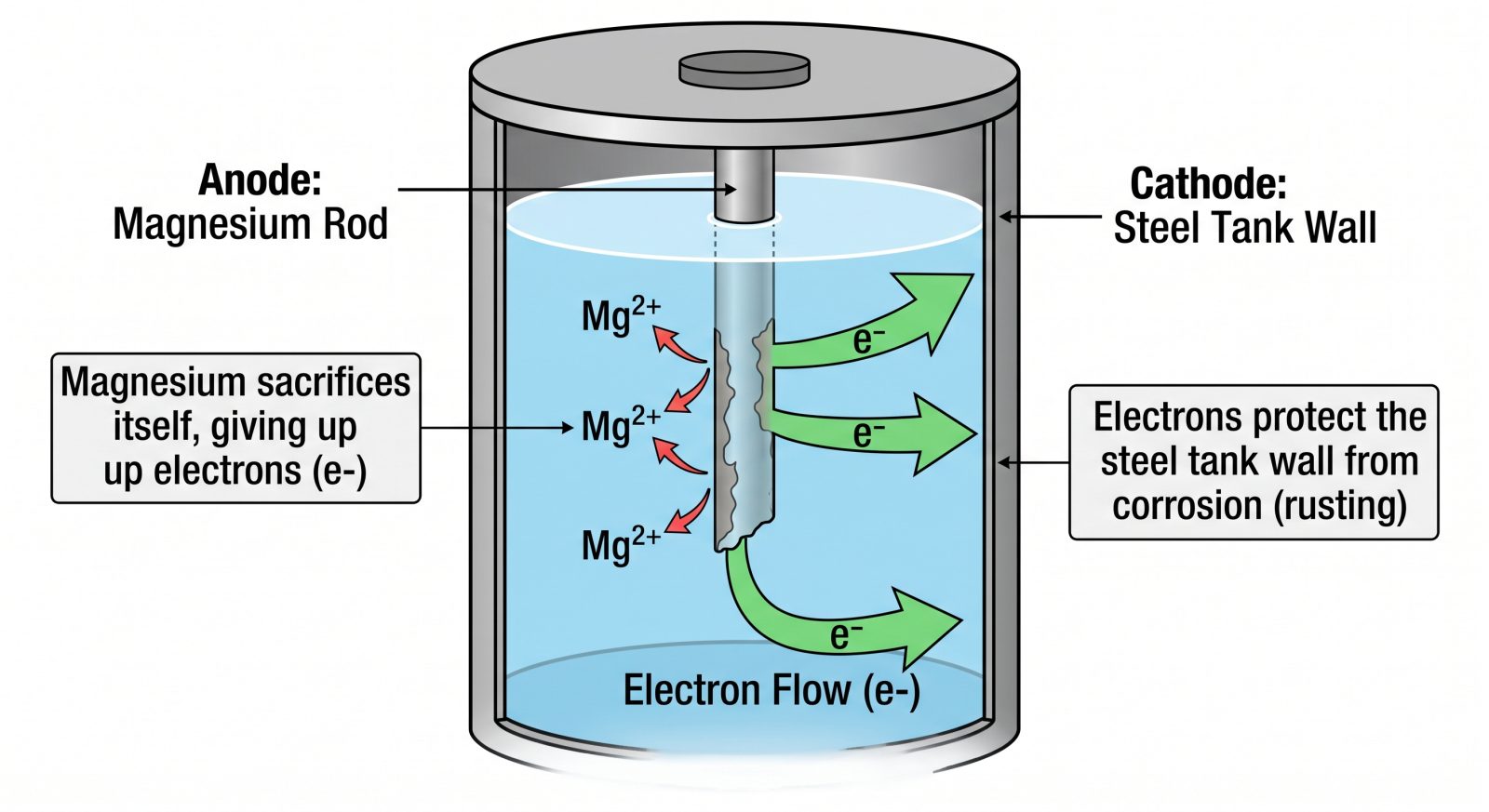
A water heater’s steel tank is protected using the same principle engineers use to protect ship hulls, buried pipelines, and underground storage tanks: cathodic protection (Wikipedia — Cathodic Protection). The anode rod is made of a metal — typically magnesium, aluminum, or a zinc-aluminum alloy — that sits higher on the electrochemical series than steel, meaning it gives up electrons more readily (U.S. Naval Academy corrosion engineering notes).
Inside the tank’s water, this sets up a small electrochemical cell: the rod becomes the anode and sacrifices itself, while the steel tank is forced into the role of cathode and stays chemically protected as long as the rod has usable material left (Petroleum Equipment Institute — Sacrificial Anode). Reliance Water Heaters’ own technical bulletin confirms that if this galvanic relationship is disrupted or the anodic material runs out, rapid tank failure can follow because the steel loses its cathodic advantage (Reliance Water Heaters Technical Bulletin #43).
How Fast the Rod Actually Wears Out
Anode rod lifespan is not fixed — it depends heavily on water chemistry, temperature setting, and usage volume. Softer water is more conductive and accelerates the sacrificial reaction, so a magnesium rod can be consumed in as little as one to two years in soft water at 140°F or higher, while the same rod might last three to five years in average municipal water conditions (WaterHeaterChecker.com).
| Water condition | Typical anode rod lifespan | Source |
|---|---|---|
| Soft water + high temperature (140°F+) | 1–2 years | WaterHeaterChecker.com |
| Average municipal water (120–130°F) | 3–5 years | WaterHeaterChecker.com |
| Hard water (high mineral content) | 4–6 years (aluminum rod) | WaterHeaterChecker.com |
| Softened water (salt-based softener) | 1–2 years | Replacement Guide |
| Low-use household (vacation home, rental) | 5–8 years | WaterHeaterChecker.com |
The practical takeaway is that “three years” sits near the fast end of that range for typical households, which is why most manufacturers and plumbers recommend a first inspection at the three-year mark regardless of water type (Replacement Guide). If your water is softened or unusually soft, the rod could already be fully consumed well before three years pass (Replacement Guide).
The Corrosion Timeline After the Rod Is Gone
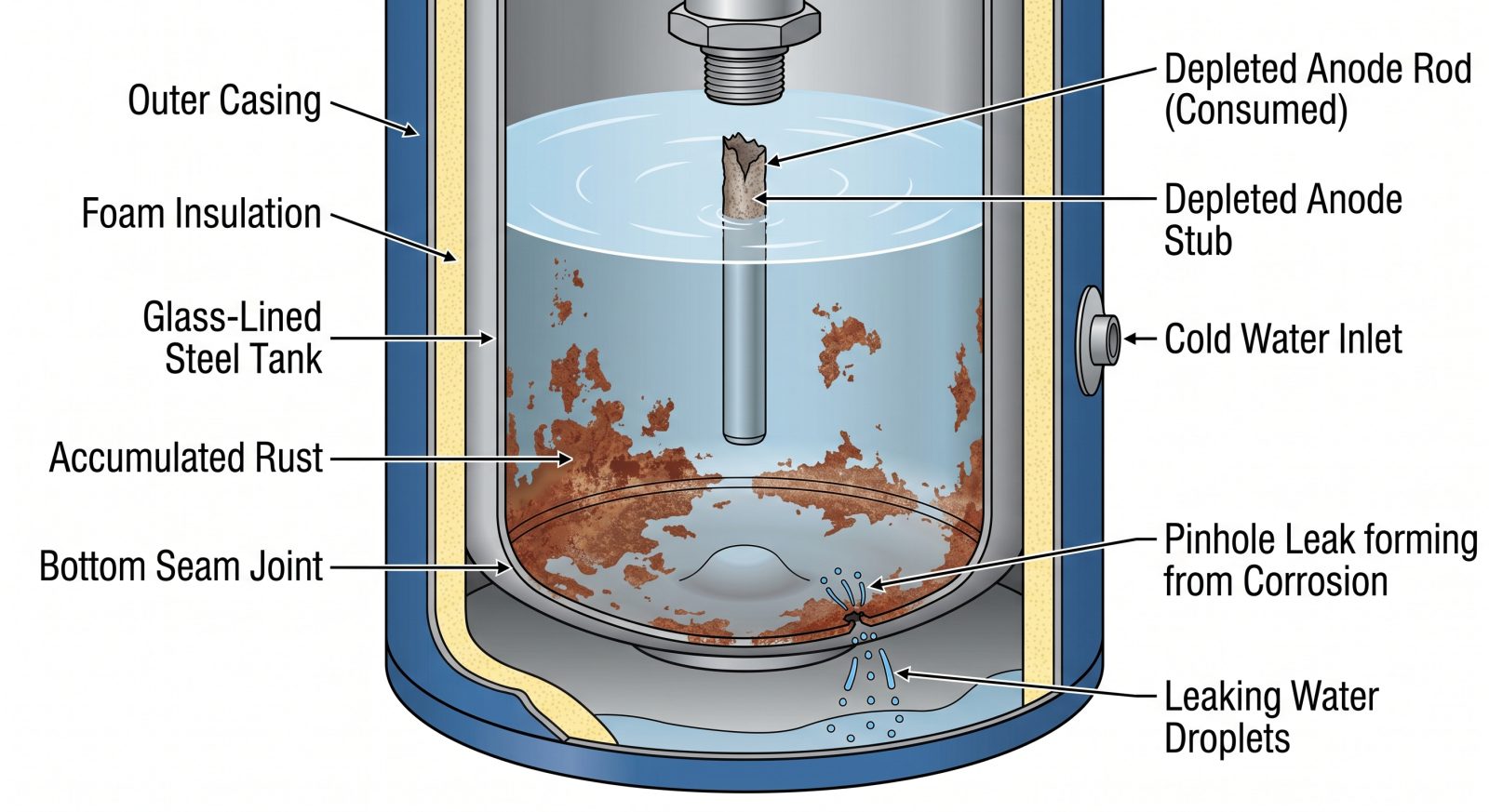
Once the anode rod’s usable metal is exhausted, the galvanic protection stops immediately — there is no gradual decline in effectiveness once the core wire is exposed (anode rod lifespan analysis). At that point, the tank’s own steel becomes the anode in the electrochemical cell it’s sitting in, and the same sacrificial process that consumed the rod begins consuming the tank wall (Plumbing Sacramento).
The interior of most residential tanks has a thin glass or enamel lining, but this lining is not perfectly continuous — any hairline crack or manufacturing gap exposes bare steel to water once the sacrificial protection is gone (anode rod failure analysis). Corrosion then concentrates at these exposed points rather than spreading evenly, which is why failures often show up as a single pinhole leak rather than uniform wall thinning.
| Timeline (rod neglected) | What’s happening inside | Visible symptoms |
|---|---|---|
| Year 1–3 | Anode rod active; tank steel fully protected | None — system working normally |
| Year 3–5 | Rod thinning rapidly; core wire becoming exposed | Possible sulfur smell; rising sediment |
| Year 5–8 | Rod fully depleted; tank steel starts oxidizing | Rusty water; popping/rumbling sounds; exterior rust |
| Year 8–12+ | Severe interior corrosion; lining cracking further | Leaking from the base; full tank failure |
Multiple plumbing sources converge on similar bracketing numbers: a tank that never gets a new anode rod after the original is depleted typically fails within 8 to 12 years total, while regular rod replacement can push that same tank to 15 to 20+ years of service (Replacement Guide)(Canada Metal Pacific). In aggressive or very hard water, a tank left with a fully depleted anode can start leaking in as little as one to two years after protection is lost (anode rod failure analysis).
Reading the Warning Signs Before a Leak
Because the rod sits fully submerged inside a sealed tank, there is no external gauge or indicator light — the only reliable way to check its condition is to physically remove it and inspect it (anode rod inspection guide). Several downstream symptoms, however, tend to appear once depletion has already begun:
- Rusty, tea-colored, or metallic-tasting hot water while cold water runs clear, indicating active tank corrosion (anode rod inspection guide)
- A rotten-egg sulfur smell from hot water taps, caused by sulfate-reducing bacteria reacting with a depleted anode (anode rod inspection guide)
- Popping or rumbling noises during heating, usually from sediment buildup that often accompanies rod degradation (anode rod failure analysis)
- A water heater older than 5–7 years that has never had the rod checked, which statistically has a high chance of already being unprotected (anode rod inspection guide)
- Visible rust streaks or a damp base around the tank exterior, a late-stage sign that internal corrosion has already progressed (WaterHeaterChecker.com)
When you do pull the rod, the physical test is straightforward: if more than six inches of the steel core wire is visible, or the rod’s diameter has dropped below roughly half an inch, it has passed the point of useful protection and should be replaced immediately (Replacement Guide).
Inspection and Replacement Schedule by Water Type
Because water chemistry drives consumption speed more than age of the unit, the safest approach is to set an inspection interval based on your local water hardness rather than relying on a single universal number.
| Water heater age / condition | Recommended action |
|---|---|
| 0–2 years | No action needed; rod is still in good shape (WaterHeaterChecker.com) |
| 3 years | First inspection due; replace if under ½ inch diameter or core wire is visible (WaterHeaterChecker.com) |
| 5 years | Inspect and likely replace; most standard rods are near end of life (WaterHeaterChecker.com) |
| Hard water or well water | Inspect every 1–2 years; use aluminum or zinc-aluminum rods (Applause Plumbing) |
| Softened water | Inspect every 1–2 years; sodium content accelerates consumption (Applause Plumbing) |
| 7–10+ years, never replaced | Replace immediately and inspect tank for early corrosion signs (WaterHeaterChecker.com) |
Choosing a Replacement Rod
Rod material should match your water chemistry rather than defaulting to whatever came with the original unit. Magnesium offers the strongest protection but depletes fastest in soft water; aluminum and aluminum-zinc alloys last longer and work better in hard or high-mineral water; and powered titanium anodes use a low-voltage current instead of sacrificial metal, giving indefinite protection without ever needing replacement (WaterHeaterChecker.com).
| Rod type | Best for | Typical lifespan | Notes |
|---|---|---|---|
| Magnesium | Soft water, standard municipal supply | 2–4 years | Most effective protection; corrodes fastest (WaterHeaterChecker.com) |
| Aluminum | Hard water, high-mineral areas | 3–5 years | Most common; resists depletion in hard water (WaterHeaterChecker.com) |
| Aluminum/zinc alloy | Sulfur-odor (“rotten egg”) water | 3–5 years | Zinc helps neutralize odor-causing bacteria (WaterHeaterChecker.com) |
| Powered (titanium + current) | All water types, especially softened water | Indefinite | No sacrificial depletion; needs a nearby outlet (WaterHeaterChecker.com) |
Switching to a powered anode does not void a standard manufacturer warranty on its own — under the Magnuson-Moss Warranty Act, a manufacturer must prove the aftermarket part directly caused a failure before denying a claim, and ignoring anode maintenance entirely is actually the more common warranty-voiding scenario (Corro-Protec — Magnuson-Moss Warranty Act analysis).
How to Inspect the Rod Yourself
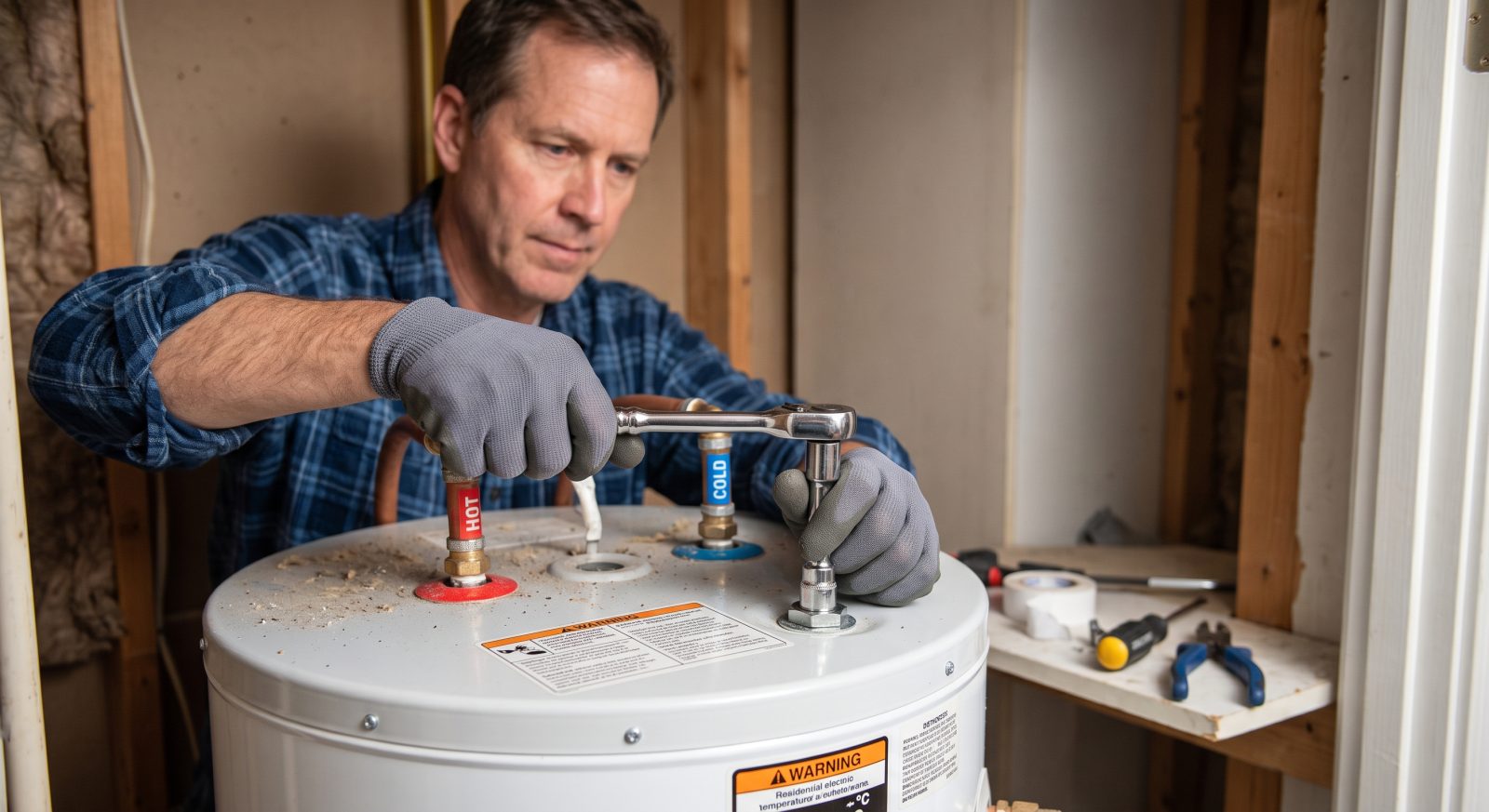
Checking the anode rod is a manageable DIY task that takes about 20–30 minutes on most standard residential tanks.
- Turn off the water heater — set gas models to “Pilot” or switch off the breaker for electric units (WaterHeaterChecker.com)
- Shut off the cold water supply valve feeding the tank (WaterHeaterChecker.com)
- Drain 2–3 gallons from the drain valve to relieve internal pressure — a full tank drain isn’t necessary just for inspection (WaterHeaterChecker.com)
- Locate the hex bolt on top of the tank, sometimes hidden under a plastic cap or combined with the hot water outlet (WaterHeaterChecker.com)
- Unscrew counterclockwise using a breaker bar or impact wrench, since factory torque is usually tight (anode rod failure analysis)
- Inspect the rod: a healthy rod looks shiny with light surface corrosion, a worn rod is heavily pitted with a gray-white coating, and a depleted rod is reduced to a bare core wire (Emergency Water Heater SLC)
Why This Matters for Overall Home Maintenance
A water heater tank failure rarely stays contained to the appliance itself — a burst 40- to 50-gallon tank can release enough water to cause thousands of dollars in flooring, drywall, and structural water damage in a basement or utility closet (anode rod neglect consequences). Anode rod inspection pairs naturally with other routine building envelope checks — homeowners auditing insulation performance or moisture barriers around mechanical rooms should treat the water heater as part of the same maintenance sweep, since a hidden slow leak can compromise nearby framing and insulation over time.
Compared to a full tank replacement costing several hundred dollars or more, a replacement anode rod typically costs between fifteen and thirty dollars in parts (Replacement Guide). That cost asymmetry is the core argument for treating anode inspection as a scheduled task rather than something to address only after symptoms appear.