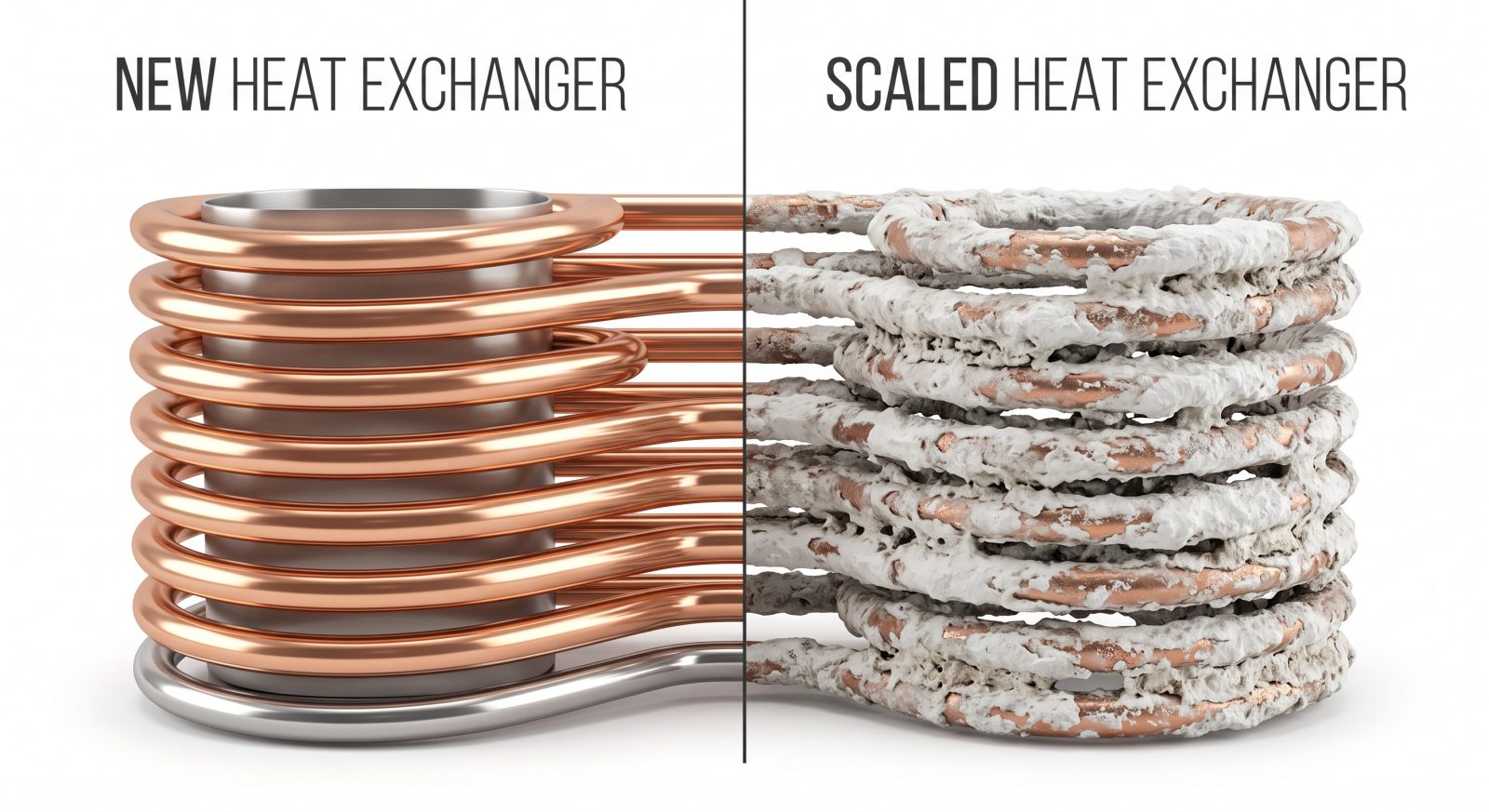
Short answer: There is no single correct descaling schedule — the right interval is set almost entirely by your local water hardness, measured in grains per gallon (GPG) or milligrams per liter (mg/L). Soft water (under 3 GPG) can often go 18 to 24 months between descalings, moderate water (3–7 GPG) generally needs it annually, and hard or very hard water (above 7–10 GPG) typically requires descaling every 6 months (TanklessGeek)(EngineerFix). Manufacturers including Rinnai, Navien, and Noritz build this hardness-based logic directly into their warranty terms (Tankless Authority).
If you’ve ever wondered whether the “descale once a year” advice printed in your owner’s manual actually applies to your house, the honest answer is: maybe not. This guide breaks down exactly how water hardness drives scale formation inside a tankless heat exchanger, what interval you should actually follow based on your GPG reading, and how skipping the schedule can quietly void your warranty.
Why Water Hardness Is the Real Variable
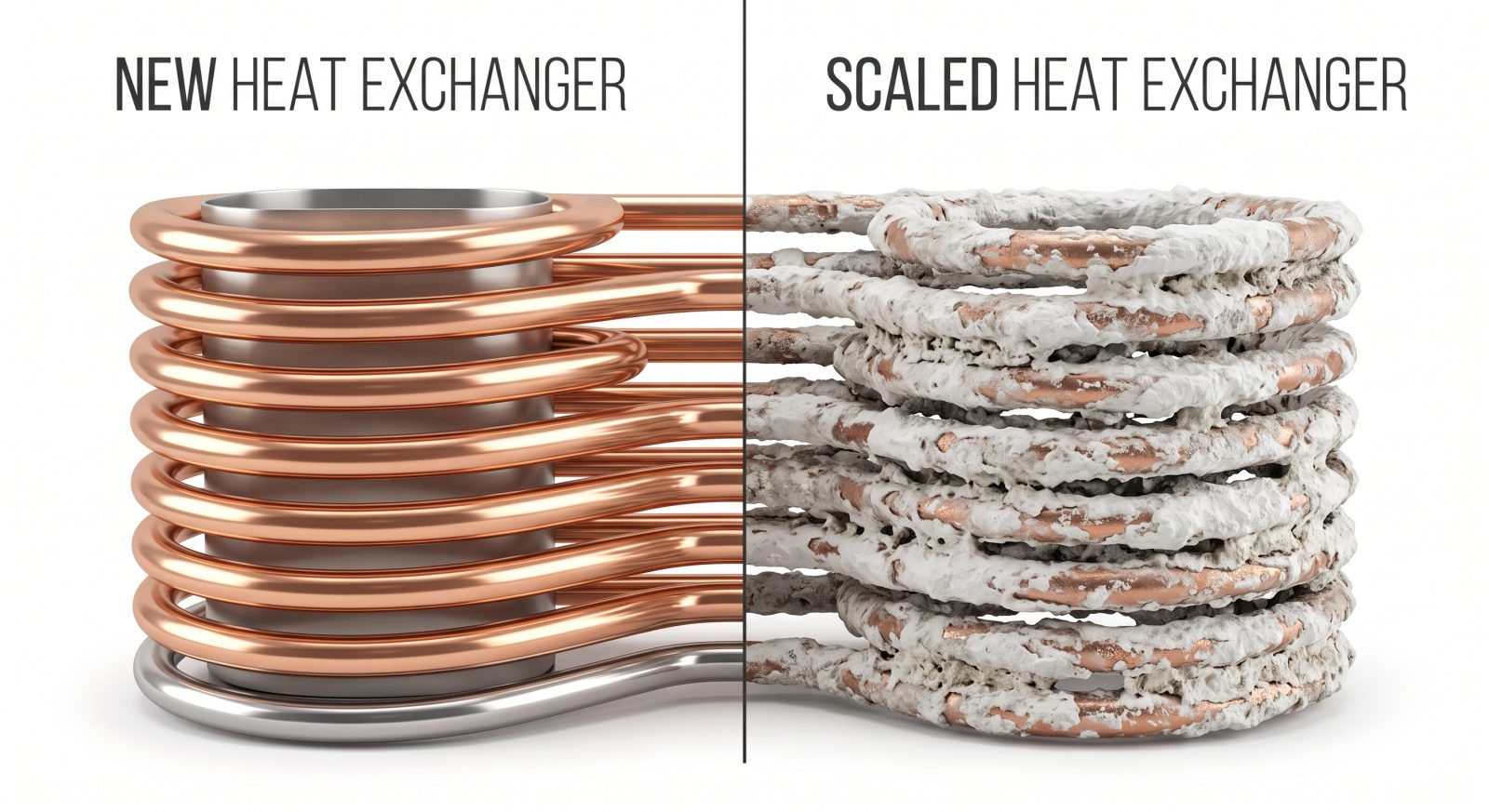
Tankless water heaters don’t collect sediment in a tank the way conventional storage heaters do — instead, minerals precipitate directly onto the surface of a compact heat exchanger every time water passes through and gets rapidly heated. Calcium carbonate and magnesium carbonate are unusual in that their solubility decreases as water temperature rises, meaning the hotter the exchanger runs, the more aggressively these minerals drop out of solution and bond to its internal surfaces (DIY Stack Exchange, citing Bosch technical documentation). The U.S. Geological Survey’s Water Science School classifies water hardness at or above 180 mg/L as “very hard,” a threshold at which scale formation inside heating equipment becomes significant within 6 to 12 months of normal operation (USGS Water Science School, via Tankless Authority).
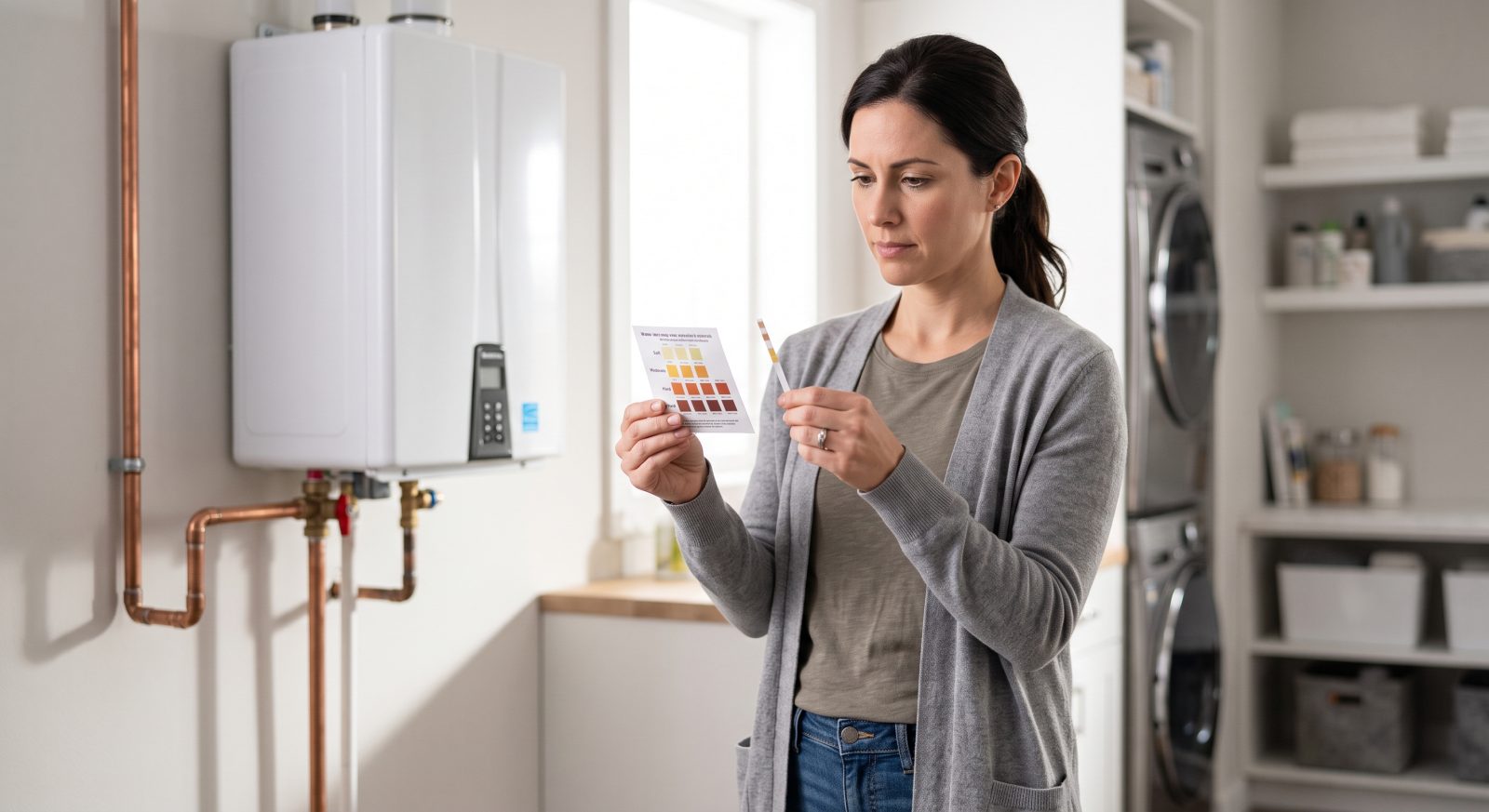
Because this is a mineral-concentration problem rather than a fixed-time problem, every credible source ties the descaling interval back to a GPG or mg/L reading rather than a flat calendar rule. You can find your local reading from a municipal water quality report, an at-home test strip kit, or a lab water test — and it’s worth doing before you set your maintenance calendar (EngineerFix).
Descaling Frequency by Water Hardness Level
| Water hardness | Grains per gallon (GPG) | Recommended descaling interval |
|---|---|---|
| Soft | Under 3 GPG | Every 18–24 months, sometimes up to every 2–3 years (ScaledPSE) |
| Moderate | 3–7 GPG | Annually (EngineerFix) |
| Hard | 7–10 GPG | Every 6–9 months (TanklessGeek) |
| Very hard | Above 10 GPG | Every 4–6 months (Water Heater Docs) |
These bands are consistent across multiple independent plumbing sources, though the exact cutoffs vary slightly by manufacturer. Some brands set their own hard limits — Eccotemp, for example, explicitly excludes warranty coverage for water hardness above 12 GPG (200 mg/L) unless a softener is installed (ScaledPSE). Rinnai specifies a service interval tied to 500 hours of operation in hard water regions, which most households reach somewhere between 6 and 12 months depending on hot water usage (TanklessGeek).
Regional Examples: How Local Hardness Changes the Math
Real-world hardness readings vary dramatically by region, and that variance is exactly why a one-size-fits-all interval doesn’t work. In Las Vegas, municipal water runs around 16 GPG — more than double the “very hard” threshold — pushing local plumbers to recommend descaling every 6 to 9 months for tankless units without a softener (Active Plumbing). In Utah’s Wasatch Front, hardness of 150–200 GPG (roughly 8.8–11.7 grains) is common, and some areas near Spanish Fork and the Uinta Basin measure 200–250 mg/L, prompting contractors to recommend descaling as often as every 4 to 6 months (Emergency Water Heater SLC).
By contrast, Charleston, South Carolina’s moderately hard water (roughly 3–5 GPG) supports a standard annual descaling schedule for most homes (Water Heater Docs). Southern Maryland well water owners with hardness above 15 GPG are advised to descale every 6 months absent a softener, while properly softened systems in the same region can stretch the interval to every 2–3 years (Deep Dive Plumbing MD). The pattern holds everywhere: the higher the local mineral load, the shorter the safe interval between flushes.
What Happens If You Skip the Schedule
Untreated scale buildup does more than reduce efficiency on the margins — manufacturers report efficiency losses of roughly 10 to 20% per year of neglected maintenance in hard water conditions (Emergency Water Heater SLC). As scale insulates the heat exchanger walls, the unit has to work harder to transfer heat, and this often shows up first as reduced flow rate, inconsistent output temperature, unusual popping or crackling sounds from steam pockets trapped under scale layers, or specific manufacturer error codes, such as Rinnai’s LC code, which flags scale-related overheating (Tankless Authority)(Cal Oasis).
The financial risk goes beyond the repair bill. Most tankless manufacturers, including Rinnai, Eccotemp, Stiebel Eltron, and Westinghouse, explicitly exclude hard-water scale damage from warranty coverage, treating it as preventable neglect rather than a manufacturing defect (ScaledPSE). If a heat exchanger fails from scale and you can’t produce dated maintenance records — receipts, service logs, or water test results — the warranty claim is likely to be denied even with years of coverage remaining (ScaledPSE).
Reducing How Often You Need to Descale
The single most effective way to lengthen the interval between descalings is installing a whole-house water softener ahead of the unit. A softener that reduces incoming hardness from, say, 200 GPG down to near 0–10 GPG can stretch the descaling interval from every 6 months to every 12–24 months, and in some cases even longer (Emergency Water Heater SLC). Southern Maryland plumbing guidance goes further, noting that a properly sized softener can extend intervals to every 2–3 years while adding an estimated 5–10 years to the overall service life of the unit (Deep Dive Plumbing MD).
Heavy hot water usage compounds hardness effects, so a large household running multiple showers, a dishwasher, and laundry simultaneously will scale up faster than a single-occupant home on the same water supply, even at identical GPG readings (EngineerFix). If you’re on the boundary between two hardness bands, it’s worth erring toward the shorter interval, especially if your household runs above-average hot water demand.
How Descaling Actually Works
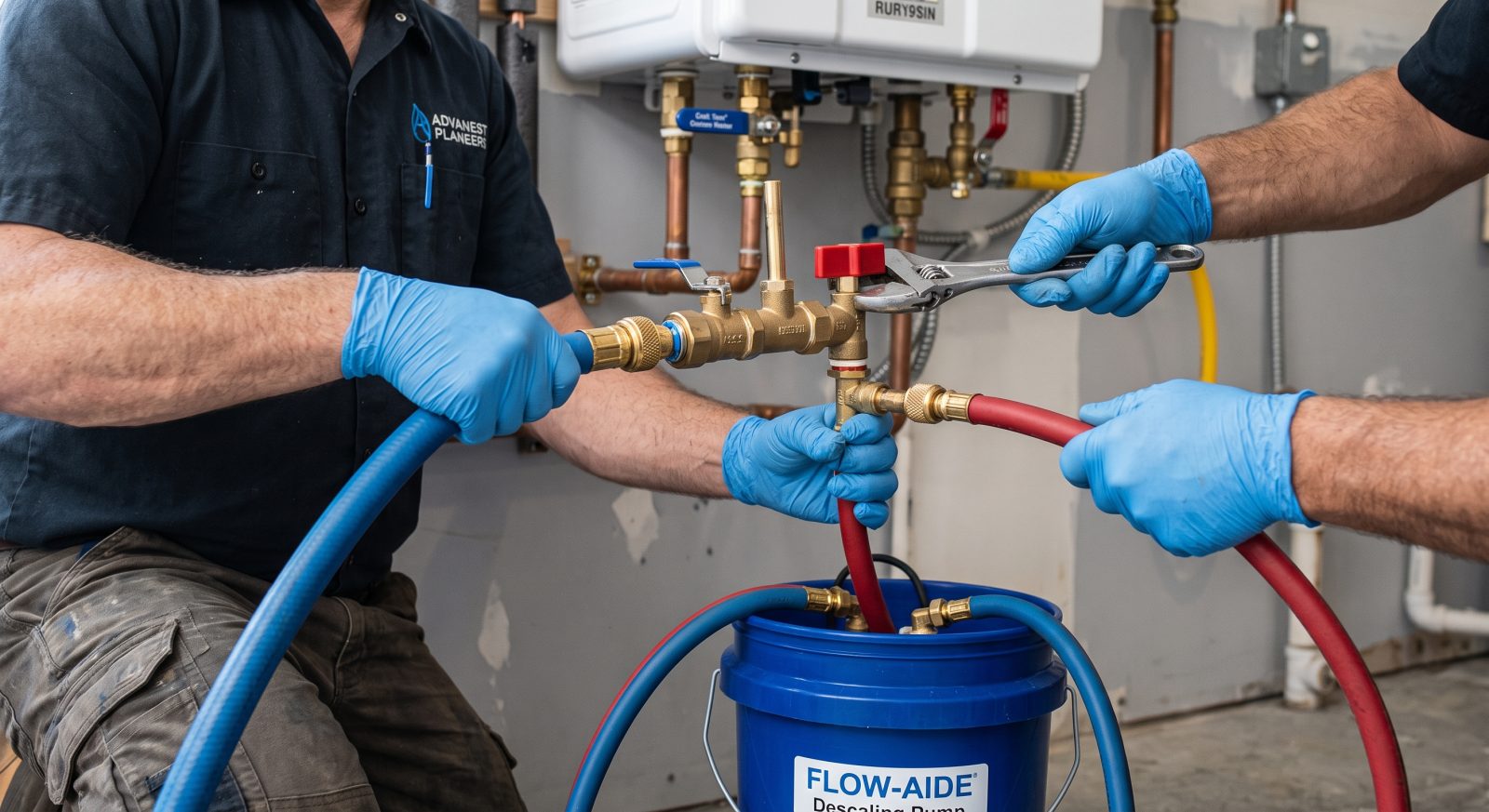
Descaling involves circulating an acidic cleaning solution — typically food-grade citric acid or undiluted white vinegar (5% acetic acid) — through the heat exchanger using a small submersible pump connected to the unit’s dedicated service valves, dissolving mineral deposits over a 45- to 90-minute flush cycle (TanklessGeek). This is distinct from a simple flush, which clears sediment and debris but does not chemically dissolve bonded scale. Most manufacturers specify acid-based descalers formulated specifically for tankless units rather than generic cleaning products, since some chemicals can damage internal gaskets or seals (Cool Wichita).
Setting Your Own Schedule
| Step | What to do |
|---|---|
| 1. Get your GPG or mg/L reading | Check your municipal water quality report or use a home test kit (EngineerFix) |
| 2. Check your owner’s manual | Compare your reading against your specific brand’s stated hardness threshold and warranty terms (ScaledPSE) |
| 3. Match your interval to the hardness band | Use the table above as a baseline, adjusting shorter for heavy hot-water usage |
| 4. Watch for early warning signs | Reduced flow, temperature swings, unusual noise, or error codes mean don’t wait for the calendar (Cal Oasis) |
| 5. Keep dated records | Log every descaling with a date and method to protect warranty coverage (ScaledPSE) |
Frequently Asked Questions
Can I just descale once a year no matter what?
Annual descaling is a reasonable default only for moderate hardness (roughly 3–7 GPG). In hard or very hard water above 7–10 GPG, an annual-only schedule usually isn’t enough to prevent scale from affecting performance (TanklessGeek).
Does a water softener eliminate the need to descale entirely?
No. A softener significantly reduces the mineral load reaching the unit and can extend intervals to every 1–3 years, but it doesn’t eliminate scale formation completely (Emergency Water Heater SLC).
What happens if I never descale a tankless unit on hard water?
Expect declining efficiency, error codes signaling overheating, reduced hot water flow, and a heightened risk that a heat exchanger failure will be denied under warranty as preventable neglect (Tankless Authority)(ScaledPSE).
Is vinegar as effective as a commercial descaling solution?
Undiluted white vinegar (5% acetic acid) works for light to moderate scale and is commonly recommended as a low-cost option, though commercial citric-acid-based descalers formulated for tankless units are often preferred for heavier buildup (TanklessGeek)(Cool Wichita).