Short answer: A GFCI outlet only protects people if it is correctly wired, positioned within code-required proximity to sinks and countertops, and passes a monthly test. A “GFCI-style” outlet face installed in a kitchen can look protective while providing zero actual ground-fault protection — most commonly because of a reversed line/load connection, a missing sink-distance calculation, or a downstream device that was never tested after installation (ExpertCE NEC 2023 miswire guide). Knowing the difference between a compliant installation and a cosmetic one is the only way to avoid a false sense of security in the wettest room of the house.
Kitchens combine water, grounded metal appliances, and a dense cluster of receptacles — exactly the conditions ground-fault circuit interrupters were designed for. But a GFCI outlet does nothing if it’s wired backward, placed with blind spots along the counter, or left unchecked for years. This guide walks through the specific placement and wiring errors that let homeowners believe they’re protected when they aren’t.
What a GFCI Is Actually Supposed to Do
A ground-fault circuit interrupter continuously compares the current flowing out on the hot conductor against the current returning on the neutral conductor. When even a small imbalance appears — typically around 4 to 6 milliamps, indicating current is leaking through an unintended path such as a person’s body — the device cuts power in a fraction of a second (Faith Electric GFCI line vs. load guide). This is a fundamentally different job than a standard circuit breaker, which only responds to overloads or short circuits, not to the smaller leakage currents that can be lethal in a wet kitchen.
Where Kitchen Code Actually Requires GFCI Protection
The National Electrical Code has expanded kitchen GFCI requirements significantly over the past decade, and many placement errors trace back to homeowners or installers working from an outdated version of the rule.
| NEC edition | Kitchen GFCI requirement |
|---|---|
| 2011 and earlier | Only receptacles serving countertop surfaces required GFCI protection (Electrical License Renewal, NEC 210.8 history) |
| 2014–2020 | Countertop receptacles plus any 125-volt, 15- or 20-amp receptacle within 6 feet of any sink — including ones behind a refrigerator or on an adjacent wall not serving the counter (NEC 210.8(A) code history) |
| 2023 | Every receptacle in a dwelling-unit kitchen requires GFCI protection, regardless of distance from the sink or countertop — including refrigerator, dishwasher, disposal, and microwave receptacles (IAEI Magazine, kitchens and GFCI requirements) |
Under the 2023 NEC, the location of the receptacle relative to the sink is no longer relevant to whether GFCI protection is required in a kitchen — the entire room is treated as GFCI territory (IAEI Magazine). Homes wired under older code cycles are not required to be retrofitted unless the circuit is altered, which is why so many existing kitchens still have unprotected receptacles that look identical to protected ones (WireRef NEC 2023 kitchen GFCI summary).
Placement Error #1: Assuming Distance From the Sink Still Matters
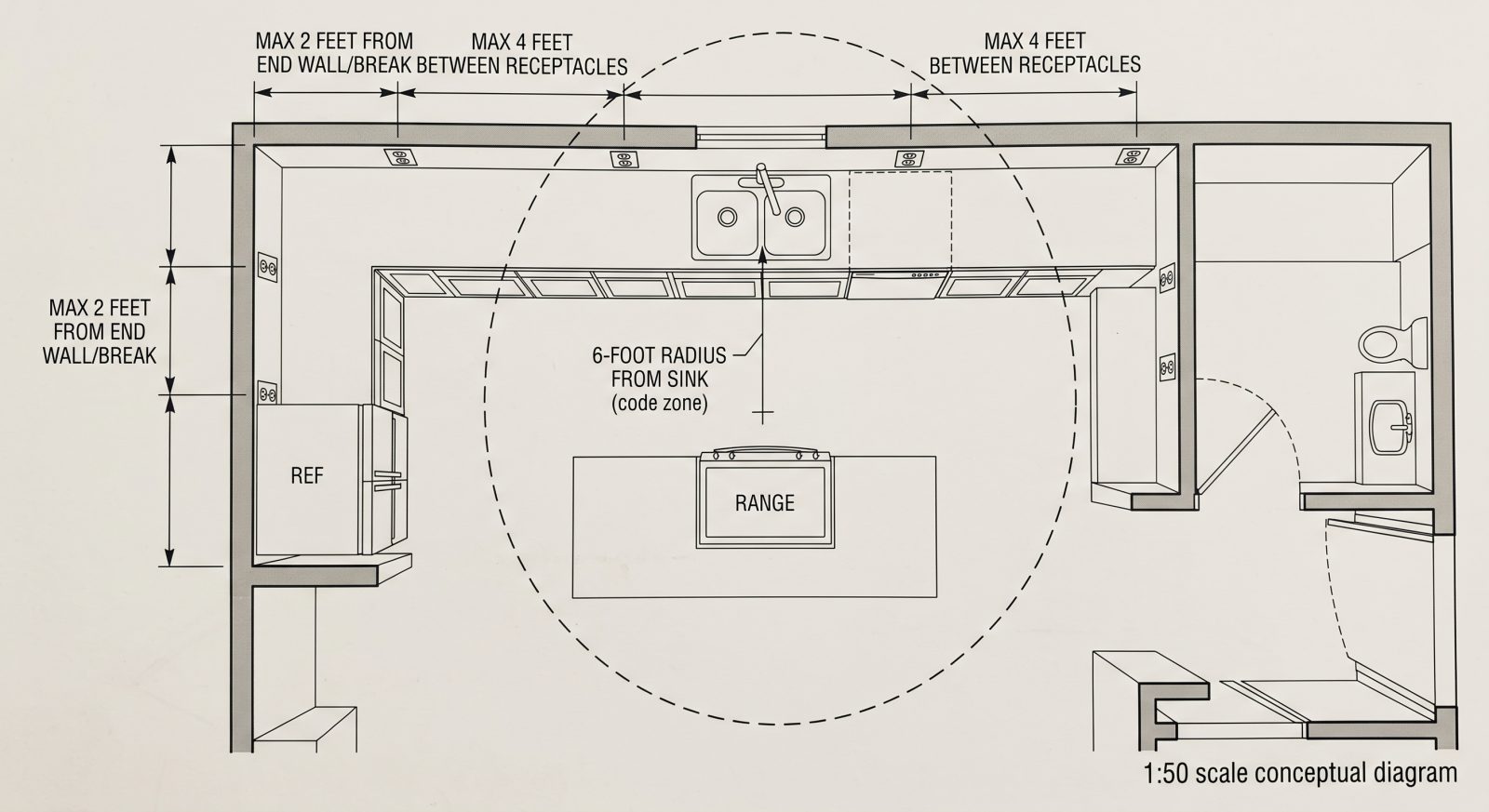
A persistent myth is that only outlets “close to the sink” need GFCI protection. Under the 2014 through 2020 NEC, that was true within a 6-foot radius, but the 2023 code removed the distance limitation entirely for kitchens (WireRef). A homeowner relying on the old 6-foot rule may leave a receptacle on the far wall — one that still serves a plug-in appliance capable of contacting water via a spilled drink or a mopped floor — completely unprotected, creating exactly the false confidence this guide addresses.
Placement Error #2: Countertop Spacing Gaps That Push Appliances Toward Unprotected Outlets
Code requires countertop receptacles spaced so no point along the counter is more than 24 inches from an outlet, commonly summarized as the 2-foot/4-foot rule (Slice It Right, kitchen GFCI compliance). When this spacing is violated — often in older kitchens or DIY remodels — homeowners plug countertop appliances into extension cords reaching a non-GFCI outlet elsewhere, defeating the protection even if a compliant GFCI exists a few feet away (The Spruce, kitchen electrical code basics).
Placement Error #3: Reversed Line and Load Wiring
This is the single most common and most dangerous GFCI installation mistake. The LINE terminals must connect to incoming power from the panel, while the LOAD terminals feed downstream receptacles that the GFCI is meant to protect (ExpertCE). When an installer reverses these connections, older GFCI models will often still deliver power to the outlet face and look completely normal, while providing zero ground-fault protection to anyone plugged into it (EngineerFix, GFCI line/load reversal).
Newer GFCI devices include a miswire lockout that prevents the unit from resetting at all if line and load are reversed, which at least signals a problem rather than silently failing (Hubbell wiring device technical literature). But older or budget devices without this feature can sit in a wall for years looking protective while offering nothing (Norske Electric, GFCI line vs. load).
How to Check for a Reversed GFCI Yourself
- Press the TEST button; if the outlet trips but the slots remain energized, line and load are reversed.
- Use a plug-in GFCI outlet tester at the device itself and at every downstream receptacle it’s supposed to protect.
- If a newly installed GFCI won’t reset at all, suspect a line/load reversal before assuming the device is defective (Faith Electric).
Placement Error #4: Assuming One GFCI Protects the Whole Kitchen
A single GFCI receptacle can extend protection to downstream outlets only if it’s specifically wired for feed-through protection using its LOAD terminals — and only for receptacles physically downstream on the same circuit (Faith Electric). A GFCI cannot protect anything upstream of itself on the circuit, meaning its placement within the wiring sequence — not just its physical location on the wall — determines what it actually covers (GFCI protection scope reference). Homeowners often assume every outlet in the kitchen is protected because one GFCI is visible, when in reality only the outlets wired downstream of it on that specific circuit are covered.
Placement Error #5: Never Testing After Installation — or Ever Again
Consumer Product Safety Commission data analyzed in industry whitepapers found GFCIs in high-humidity environments have a 10.5% non-operability rate compared to 7.3% in dry areas, meaning roughly one in ten kitchen-adjacent GFCIs in humid conditions may already be silently failed (CPSC data analysis, contractor whitepapers). That same data shows GFCIs in bathrooms are about twice as likely to fail as those in kitchens, but kitchen units are not immune, since moisture from steam, dishwashing, and spills still degrades the internal solenoid over time (CPSC data analysis).
Manufacturers and code officials recommend testing every GFCI monthly using the built-in TEST and RESET buttons (DexDecor GFCI code compliance guide). A GFCI that was correctly wired on day one can still fail silently years later — the outlet keeps supplying power, so nothing at the wall signals the loss of protection.
Placement Error #6: Islands and Peninsulas Without Required Outlets — or the Wrong Kind
The 2023 NEC and 2024 IRC removed the requirement to install any receptacle on kitchen islands and peninsulas, but if one is installed, it must still meet strict placement rules: no more than 20 inches above the countertop, or built into a listed countertop or work-surface assembly (InterNACHI, kitchen island receptacle requirements). Placing a standard, non-GFCI receptacle in a wet island zone specifically because “the code doesn’t require an outlet there anyway” is a common gap that creates an unprotected point of contact directly beside a sink or prep area.

Comparing a Compliant Installation to a False-Safety Installation
| Feature | Compliant GFCI installation | False-safety installation |
|---|---|---|
| Line/load wiring | Incoming power on LINE, downstream receptacles on LOAD, verified with a plug-in tester (ExpertCE) | Reversed or mixed terminals; outlet powers appliances normally but never trips on a real ground fault (EngineerFix) |
| Coverage scope | Every kitchen receptacle GFCI-protected per current NEC, or explicitly mapped for older code cycles (IAEI Magazine) | Only receptacles “near the sink” assumed protected, based on outdated 6-foot rule |
| Testing routine | Monthly TEST/RESET checks, periodic tester verification at downstream outlets (DexDecor) | Installed once and never checked again, despite elevated failure rates in humid conditions (CPSC data) |
| Island/peninsula outlets | Height and mounting comply with 20-inch and listed-assembly rules (InterNACHI) | Standard receptacle installed in a wet prep zone with no GFCI protection |
Practical Checklist for Verifying Kitchen GFCI Protection
- Identify the edition of the electrical code your home was wired to, since it determines which receptacles legally require GFCI protection.
- Test every kitchen GFCI monthly using the TEST and RESET buttons, and confirm downstream outlets lose power during the test.
- Use a plug-in GFCI outlet tester to confirm correct line/load wiring rather than relying on visual inspection alone.
- Map which receptacles are actually downstream of each GFCI device — physical proximity on the wall does not indicate electrical protection.
- Treat any outlet that “still works” after years of use as unverified until tested, since a failed GFCI can continue supplying power while offering no protection (CPSC data).